

Last year, my coach, mentor, and dear friend Anand Rao, led the first cohort of its kind for paid subscribers to this newsletter.
It was called Augmented Awakening, and the focus was on using AI for deep self-understanding and transformation, rather than just productivity.
Today, I announce Augmented Awakening 2.0, which will happen every Tuesday at 11:00am-12:30pm EST starting June 9 and run for a year:
June 9, 2026
July 17, 2026
August 4, 2026
September 8, 2026
October 13, 2026
November 17, 2026
December 8, 2026
January 12, 2027
February 9, 2027
March 9, 2027
April 13, 2027
May 11, 2027
The live and on-demand classes and accompanying skills are only available to paying members of this newsletter. This means you get all of the benefits of this newsletter ($2,000+ value) in addition to this new class for just $20/month. To put this in context, Anand’s private coaching commands $1,000/hour.
What’s New
This year’s cohort is going to take on a new flavor in two ways:
Change #1: From Simple Prompts To Complex Skills
First, rather than just sharing prompts, we’re going to share complex skills that can be used in chat tools (ChatGPT, Claude.ai) and agentic tools (Claude Cowork, Codex, Claude Code) that do way more. You can read more about Tuesday’s skill below.
Change #2: From Chat Paradigm To Agentic Paradigm
Second, we’re adapting to the new world of AI. Each session will focus on the aspects of awakening that are most threatened, or that offer growth opportunities that weren’t possible before.
About Anand

Anand is the most transformative coach that I’ve ever had the fortune to work with:
Anand is incredible at understanding and reframing “problems” at a root level.
He uses interventions that lead to effortless and elegant change in areas that seemed previously “impossible” to change.
He uses a unique fusion of change work approaches you can’t get anywhere else (adult development, emotional regulation techniques, neurolinguistic programming, hypnosis, and other techniques he has pioneered).
Once the basic life necessities are taken care of, personal growth is the highest leverage way to make the most out of our life IMHO. A small, deep change can have enormous effects in every area of our life.
Before becoming a full-time coach, Anand had a conventional technical background in theoretical physics and engineering. But then, he made a very unconventional career decision. Rather than maxing out his career in engineering, he focused on becoming a highly-paid consultant so he could work just a few hours per month.
This gave him extra time to make personal evolution his #1 focus. During this time, he sought out and learned directly from many of the world’s top change-work practitioners.
As a result of 30+ years of compounding, Anand now has the most distinctive and effective mix of change-work modalities I’ve ever seen. His approaches are a mix of:
Mixed method (objective (science-backed) and subjective (intuitive))
Multi-modal (intellectual and emotional and somatic and energetic)
Multi-pedagogical (explanatory and experiential)
Normally, someone of Anand’s coaching level would be known across the world. But being widely known is not what drives him. Therefore, working with him now in intimate settings is a special opportunity.
Preview Of Next Tuesday’s Session (From Anand)
The Topic
You’ve probably noticed this already.
Building anything useful used to be the slow part.
Now you can start almost anything in an afternoon, point an agent at it, and go.
You handed it over in the morning, went off and did something else, and it worked away on its own. Good. That is new, and it is a kind of freedom.
Sit with it one more second, though. Feel your feet on the floor.
What were you really aiming it at? And under that, a stranger question. Was the thing you pointed it at actually yours, or just the one that was loudest that morning?
That second question is key.
Here’s why:
How It Starts: When you can start anything in an afternoon, you start a great many things, and each one feels important when you begin it.
How It Ends: You end up busy, productive even, and not at all sure any of it is the thing you would have chosen if you had stopped to choose. This can ultimately lead to burnout or, at the very least, overwhelm.
The building is handled now. The aiming is the part nobody is teaching.
So the skill that’s got lost in the mix is…
Prioritization
That is what next Tuesday is. It is the first session of a new run we are starting, and I wanted it to open right here, because this is the skill that sits underneath all the others.
What We’ll Do Together
We sit down and work, live, with the AI turned back on you as a mirror rather than an oracle. You lay your whole plate out, in no order at all, every project you have going or are tempted to start. And we use it to think clearly across the lot. Where the real reasons are. Where you are quietly telling yourself half a story. What a given thing would really cost you, in time and in the other things you would have to set down to do it.
You’ll leave holding the skill itself, a thing you keep and run before you build anything. It asks you what you would skip past, and it sorts the mess. And it keeps a quiet record of how you have been choosing, so each time you come back, it knows your patterns a little better. You get sharper at the one thing, choosing, by doing it.
One Caveat
I want to be straight about one part. It does not decide for you, and it will not save you from a hard call. All it does is make sure you are looking, across everything, before you set something loose. The deciding stays yours. That is the whole point of it.
Who It’s For
And you do not need to already be good at this to come. Most of us were never taught it, and the agents have just made it the thing that matters most. If you build with them every day, you will feel this sharply. If you have barely started, even better. You get to learn the aiming before the speed runs away with you.
The agents will build whatever you point them at. They are very good at building. Where you point them is the part that is still yours, and how you choose what to build turns out to be how you lead them. And how you lead yourself, for that matter.
So, before you point them anywhere, what kind of agent leader are you?
Bring your whole messy plate on Tuesday. Even the half-finished one you keep meaning to get back to. We will make sense of it together.
Tuesday, June 9, 11:00 to 12:30 EST.
See you in there.
Anand
PS - Michael wrote the section below to give more context on the agentic shift that’s going on and why Tuesday’s topic is particularly timely.
Five Ways The Agentic AI Shift Causes Impedes Personal Growth And Causes Overwhelm (From Michael)
AI makes us more productive.
So, you would think that this efficiency would give people more free time and more peace of mind.
But the opposite is actually true.
The people in the industry most impacted by AI are working harder than ever:
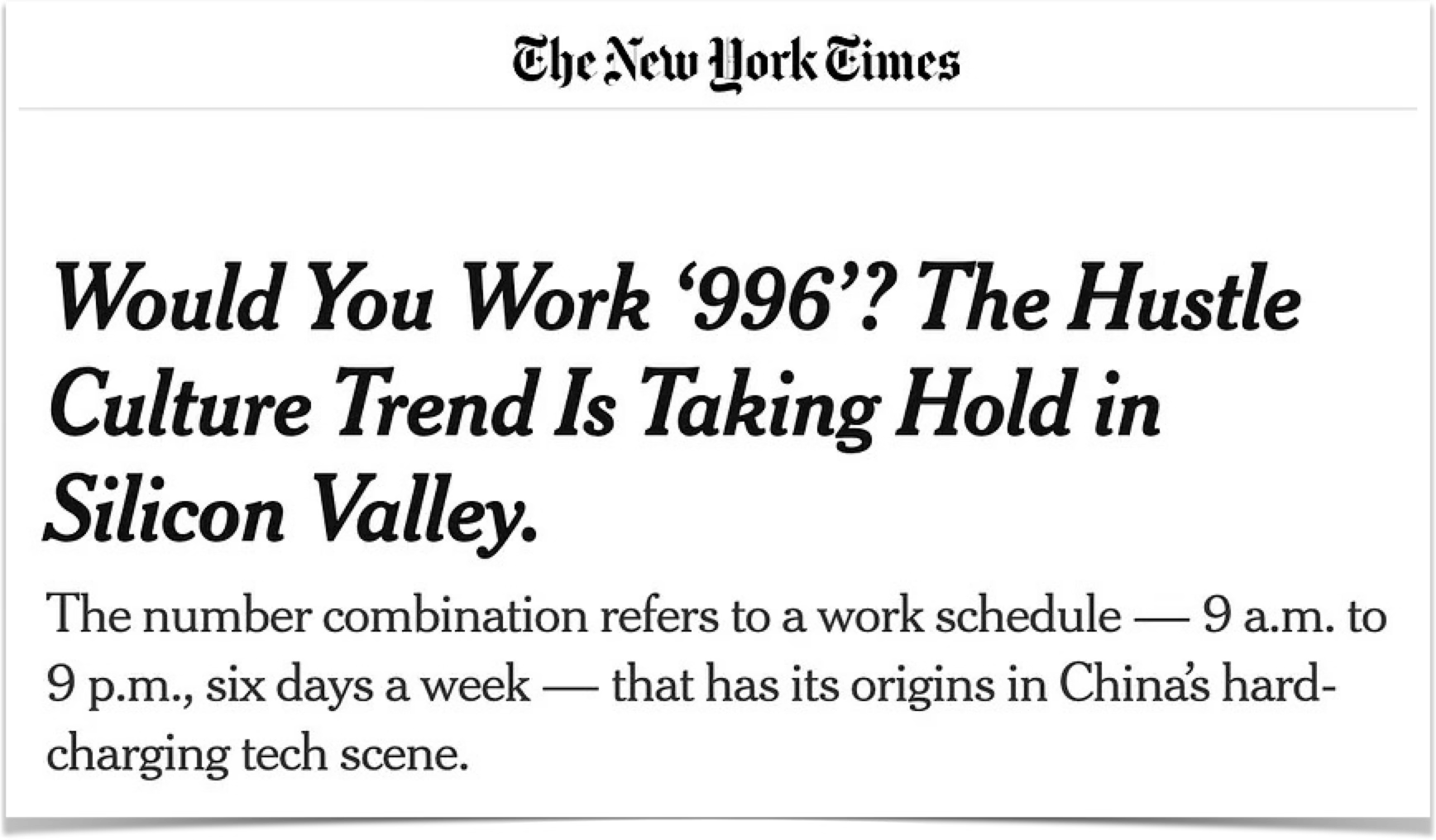
Steve Yegge, a legendary programmer who has held senior positions at Google and Amazon, takes us behind the scenes of what’s happening:
Source: The Programmatic Engineer
I believe there are five primary reasons why this is happening:
Abundance creates scarcity
Better AI leads to more work
The Red Queen Effect causes us to work harder and stay in the same place
Companies expect more
The New AI work requires more energy
By understanding what’s happening, you’ll be able to avoid the downsides of the coming productivity boom.
Reason #1: Abundance creates scarcity
You would think that abundance is only a good thing, but a hidden dynamic that few people realize is that many forms of abundance also create scarcity.
Most famously:
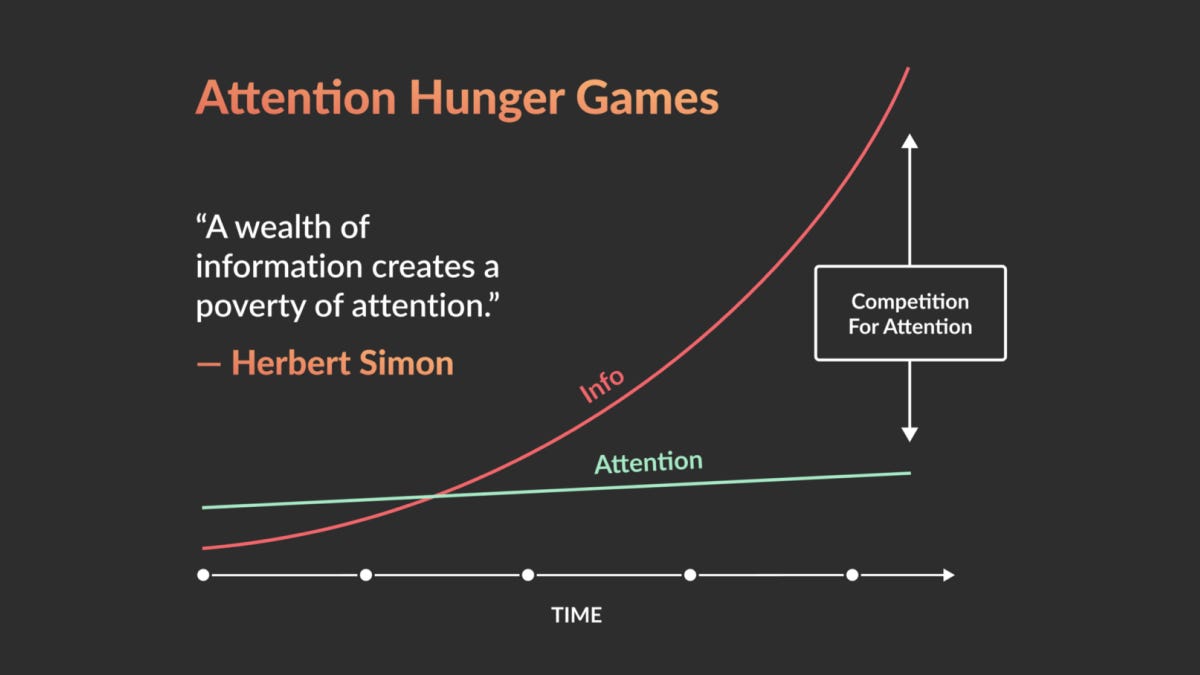
There are many other examples:
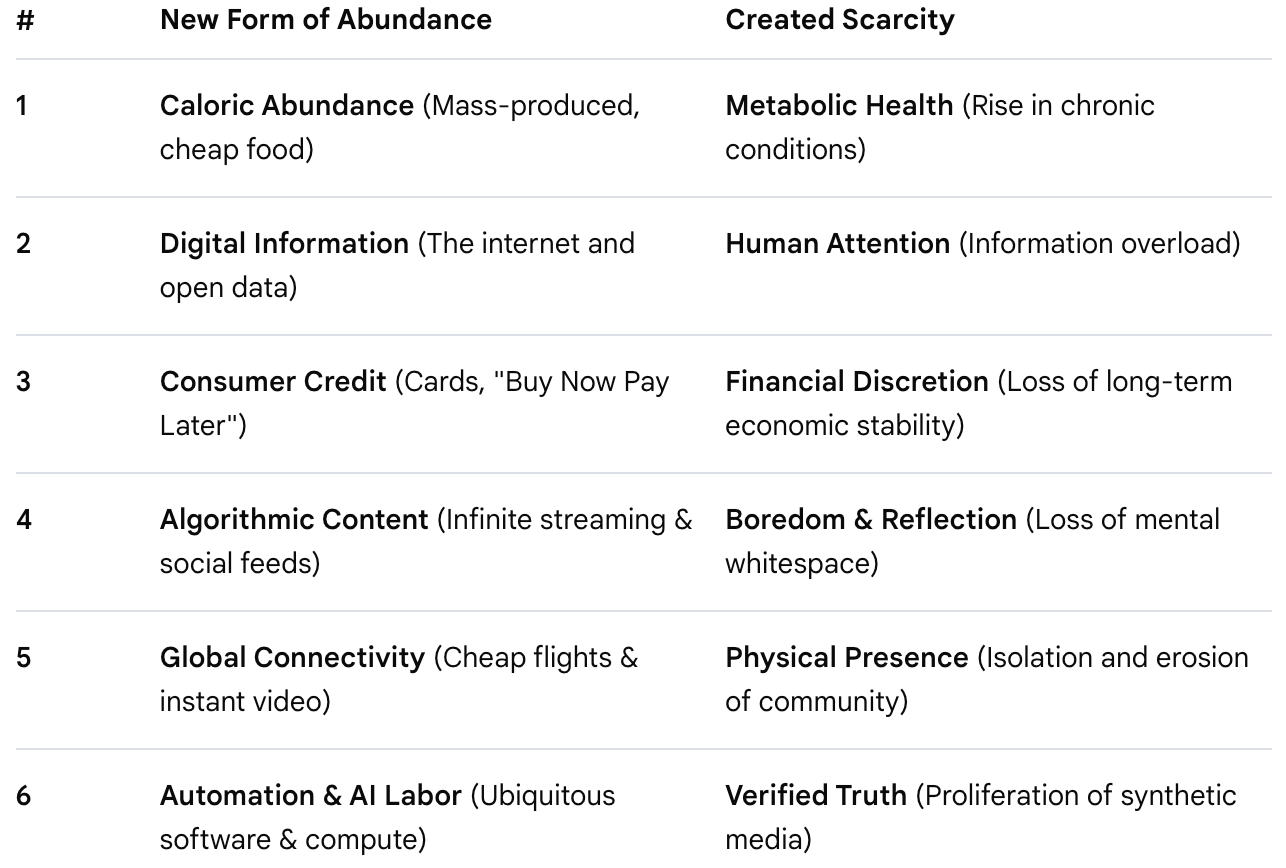
It’s now easier than ever to start a million projects and then be stuck managing them all.
Reason #2: Better AI leads to more work
As AI improves, it suddenly becomes possible to build way more things that weren’t economically feasible before. Thus, as AI improves, the universe of work increases. Aaron Levie, founder of Box (value: $3.7B), explains in an X post:
Sorry to anyone who thought AI would mean we’d work less (at least for now). AI makes it easy to explore more than you did before, and so you start doing far more as a result.
I regularly have seemingly small things that end up quickly consuming 3 hours because the agent made it easy to get started, but you still have to do the rest of the work to complete the project.
This is work that I wouldn’t previously have handed out to anyone else, it’s just stuff that never got done because it took too long to do fully manually. And, counterintuitively, for some of these tasks as AI gets good enough at doing them, it even becomes economically worth it to hire someone to do it on an ongoing basis with agents. But until you could try doing them at a low cost you would never have tried.
This is why AI won’t automatically reduce work in the way we imagine because work isn’t static. Most companies have far more they can do than they have today, it was just hard to get started on it all because of the natural constraints of time and labor availability.
—Aaron Levie on X
Reason #3: The Red Queen Effect causes us to work harder and stay in the same place
There’s a scene in Lewis Carroll’s Through the Looking-Glass where Alice is running as fast as she can alongside the Red Queen, yet the scenery never moves. She points out that back home, running that hard would get you somewhere. The Queen replies: “Now, here, you see, it takes all the running you can do, to keep in the same place.”
A century later, in 1973, the evolutionary biologist Leigh Van Valen turned that scene into a law. In his paper “A New Evolutionary Law,” he showed that species are locked in a permanent arms race with the species around them. A rabbit that evolves to run faster doesn’t stay safer for long, because the foxes evolve to run faster too. Everyone is improving, so improvement stops being an advantage. It becomes the price of staying alive. He called it the Red Queen Effect.
This is exactly what’s happening with AI, and it’s the part people miss when they picture AI handing everyone more free time.
When you were one of the first to use AI well, it was a real edge. You got more done than the people around you. But the trap is this: everyone else got the same tools at the same time. So the moment your 3x output becomes normal, it stops being an edge and quietly becomes the new baseline. You’re no longer running to get ahead. You’re running not to fall behind. And because the tools get better every few weeks, the baseline keeps moving, so the running never stops.
It’s the cruelest version of progress. The faster everyone goes, the harder you have to push just to stay in the same place.
And this dynamic doesn’t stay abstract. It shows up in a very concrete place: your job. Which brings me to the next reason.
Reason #4: Companies expect more
I’ve talked to countless employees one-on-one about AI. I almost universally hear the same thing. Leadership expects everyone to be more productive and to learn AI on their own. Rather than providing guidance, many leaders impose restrictions on what tools and data can be used.
Steve Yegge explains:
Source: The Programmatic Engineer
Reason #5: The new AI work requires more energy
Source: The Programmatic Engineer
Bottom Line
As AI helps us become more productive, we need to be more intentional.
If we aren't, we’ll end up running faster and stay in the same place.
Augmented Awakening 2.0 brings that intentionality to how we collaborate with AI.
All you have to do in order to join is become a paid subscriber of this newsletter for $20/month: