

Announcement
Wyndo and I run the Agentic Academy Mastermind, a year-long program that offers monthly bootcamps and ongoing community to help you reinvent how you develop, package, distribute, and monetize expertise in the age of AI. In month 1, we shared the easiest way to start vibe coding. In Month 2, we shared how to make animated videos with AI.
Our next bootcamp is this Friday at 11:00am-2:00pm EST. It’s about the question we keep coming back to:
How do people who sell what they know get paid when their clients ask AI first?
This guide is our answer so far. If you want to build your own version with us, the details are at the end.
This Is A Guest Post From Wyndo

Now, let’s dive into today’s post written by Wyndo and brainstormed with me.
Full Article
One of your clients and customers have a question you could answer. Five years ago they’d have emailed you, searched your blog, or bought your book. Today, more and more of them just ask ChatGPT or Claude.
I know this because I do it myself. When I need to figure something out now, I ask my AI first. It goes out, gathers what’s there, and brings it back to me. That includes the experts I follow. Their ideas in their newsletters mostly reach me through my AI, which reads them first and tells me which parts are worth my time.
Saying the quiet part out loud: AI fundamentally disrupts how expertise is built, packaged, and sold. In other words, if you sell what you know, through coaching, consulting, a course, a book, a paid newsletter, or a community, this changes how readers find you and how you get paid.
In this guide, I’ll show you:
What’s changing in how people reach your work
What an MCP is, and why it matters if you sell what you know
How an AI skill lets you give clients more of your judgment, your way of thinking, and your domain expertise, right inside their own AI
Three ways to make money with an MCP, with real walkthroughs and the math for your own business
One thing you can start this week, even if you’ve never published anything on the Internet.
Before continuing, you might want to subscribe to the Agentic Academy newsletter:

Now, let’s explore...
AI is becoming the middleman between you and your clients or customers
When a client or customer asks their AI something, the AI decides whether your work is part of the answer. The only way you get found is if it decides you add something unique—a perspective that comes from a deep knowledge domain—points to you, and they click.
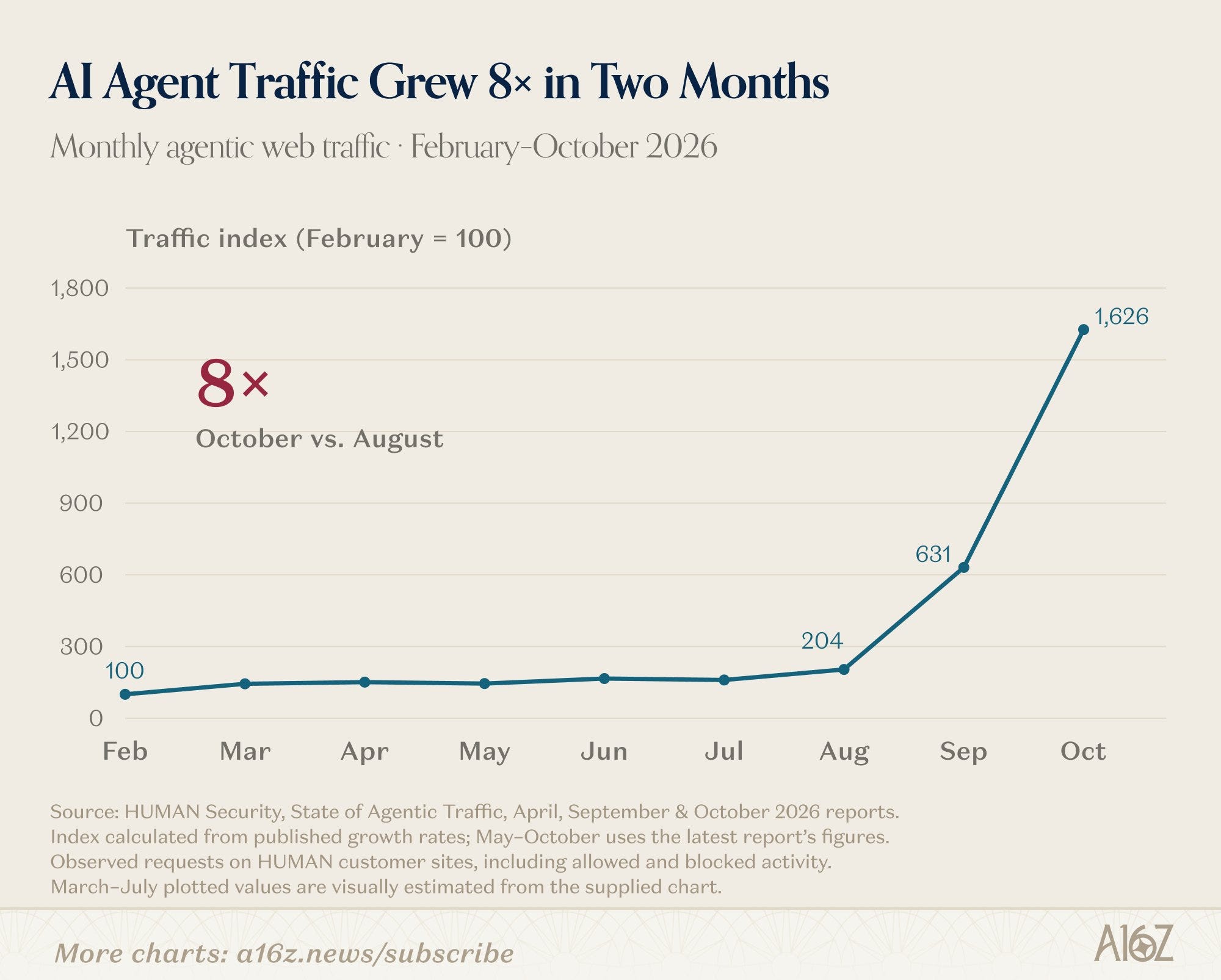
And this is moving fast. A recent analysis by HUMAN Security monitors, AI agent traffic grew about 8x between August and October 2026:
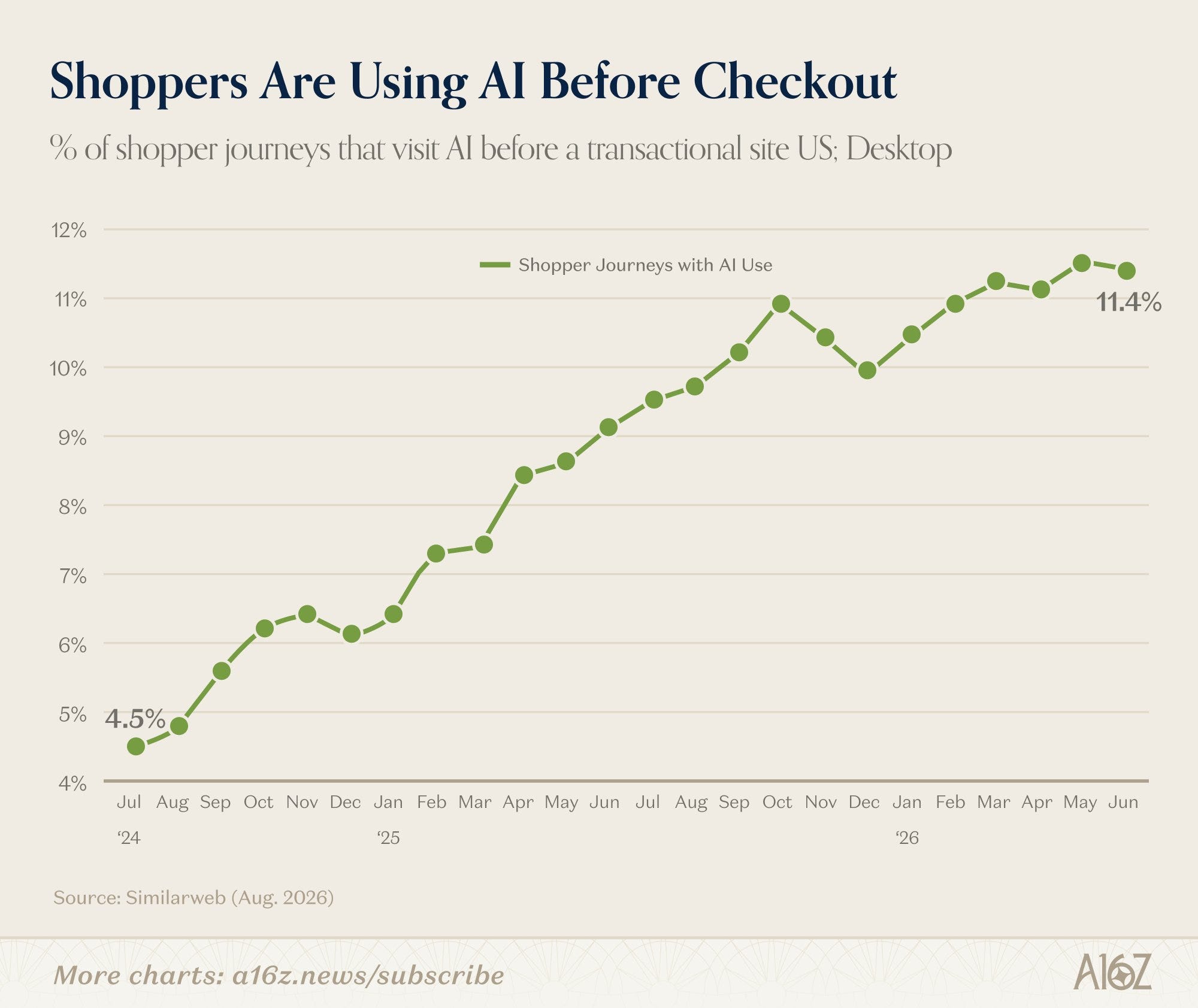
Purchasing something on the internet is moving the same way. In July 2024, about 4.5% of US desktop shopping trips included a stop at an AI tool before the store. By June 2026, it was 11.4%, according to Similarweb:
Writers are already feeling it.
Dan Shipper, who runs Every, said on Nathan Barry’s show that his AI assistant now handles most of his email:
“I really don’t look at my inbox that much. [...] Mostly my [AI assistant] handles everything. [...] My [AI assistant] has never been like, ‘Hey, this newsletter came in that you should read that you would like.’ [...] It’s going to be a rude awakening in two years when you’re like, ‘My open rate is zero.’”
Now, swap “newsletter” for your course, your book, or your coaching program, and it’s the same problem. If your clients’ AIs don’t pass your work along, your clients will never see it.
Dan’s answer so far: Every, the company, now has its own MCP (Model Context Protocol).
In a second, I’ll breakdown exactly what a MCP is, but first I’ll tell you why it’s so important.
More and more people are buying less information
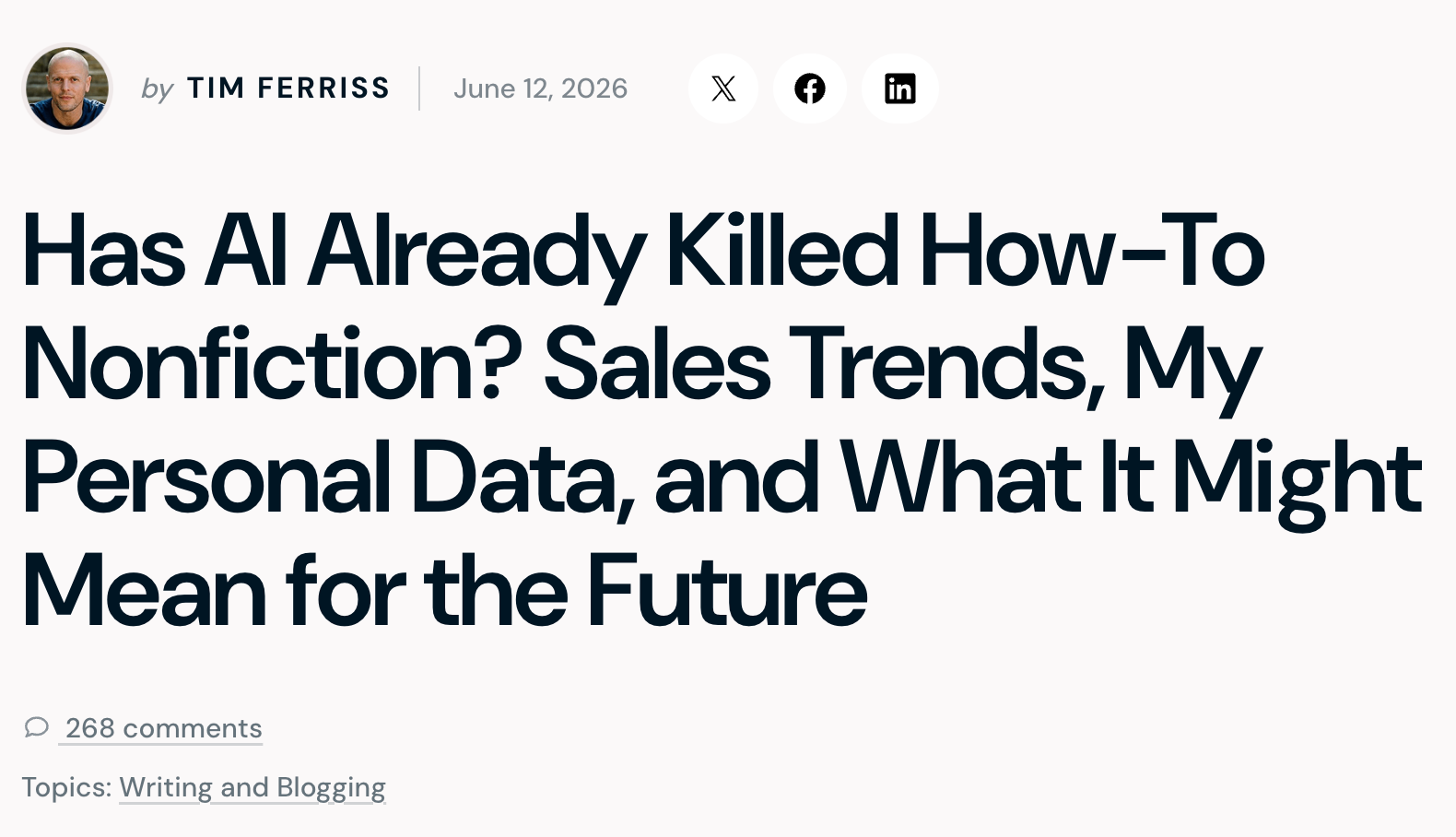
Book sales show where this goes. In June, Tim Ferris shared how his book sales plummeted, and he thinks the root cause is AI.
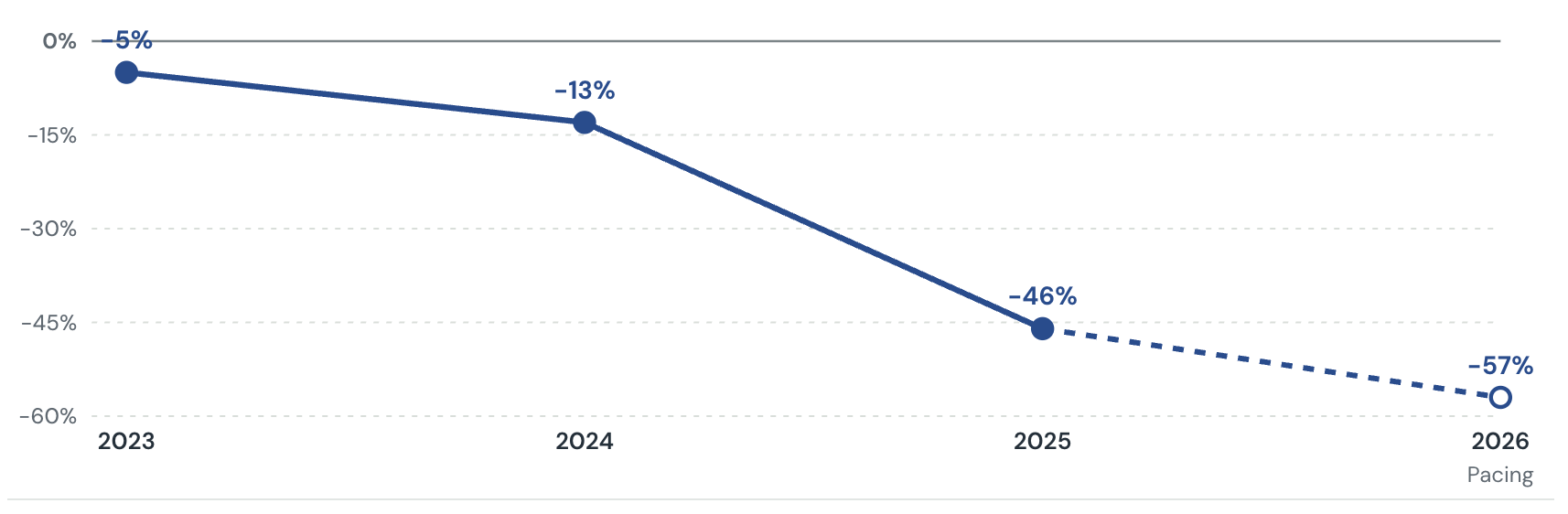
According to Ferriss: US print sales of his how-to books fell 46% in 2025 and are on pace to drop another 57% this year.
He even goes as far to make the case that his books are effectively lookup tables, saying that millions now believe a chatbot can give them a plan fitted to their own life in seconds, based on the book.
I want you to pay attention to this, because it’s important for people who sell their domain expertise to others.
Everything you write down holds two things:
There’s the information: the steps and how-to anyone could look up.
And there’s your judgment: how you’d adjust when a client’s plan stalls, what you’ve learned from the people you’ve helped, what you’d tell this person about their situation.
For years, those two came bundled in the same book or course. AI is pulling them apart. A chatbot can already hand someone your steps. A chatbot can also run research and create a personalized plan that suits their needs. But what it can’t do on its own is make the calls you make with a client in front of you.
So the question for anyone who sells expertise becomes:
How do you get paid for your judgment when the first thing reading your work is someone else’s AI?
What I think people will pay for is work done better than their AI can do it alone. That means your judgment written down as steps their AI can follow: your frameworks, the questions you ask, the checks you run, etc. You can convert your judgement into something that AI can use and follow. This is mostly known as a skill. With one, your clients’ and customers’ AIs do the job the way you would, on their own material, and save them the hours it would have taken.
An MCP is how those skills get inside your clients’ AI, behind a sign-in you control. Every time you improve a skill, they get the better version without reinstalling anything.
What an MCP is, in plain words
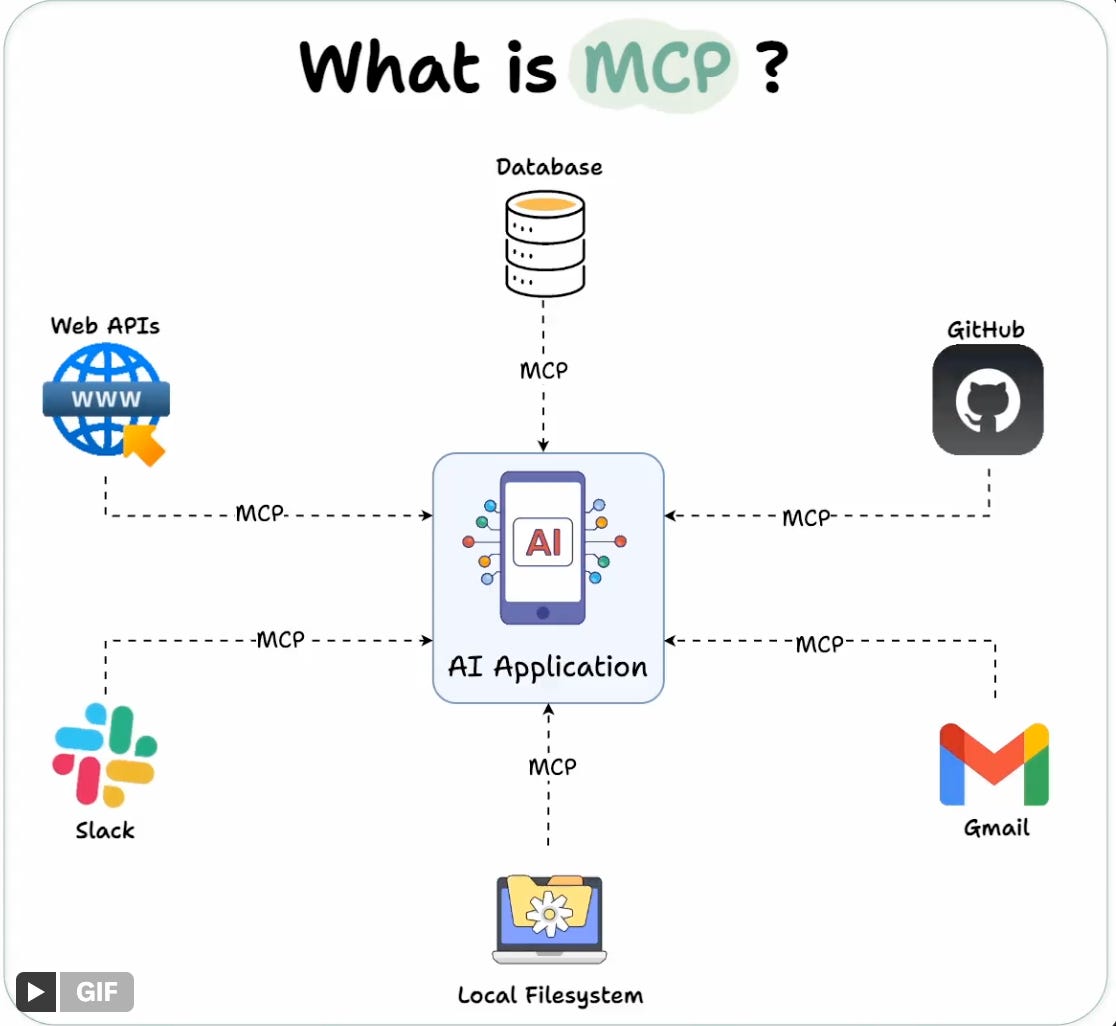
MCP stands for Model Context Protocol. It’s the standard way an AI like Claude or ChatGPT connects to outside apps and data.
You’ve probably used one already without knowing the name. In Claude, they’re called connectors. In ChatGPT, they show up as plugins. When you connect Gmail, Notion, Google Drive, or Google Sheets, your AI can search your email, read your notes, and pull numbers from your spreadsheets right inside the chat. Each of those connections runs on MCP.
Both Anthropic and ChatGPT now have marketplaces that make the discovery and installation of these connectors fast and easy:
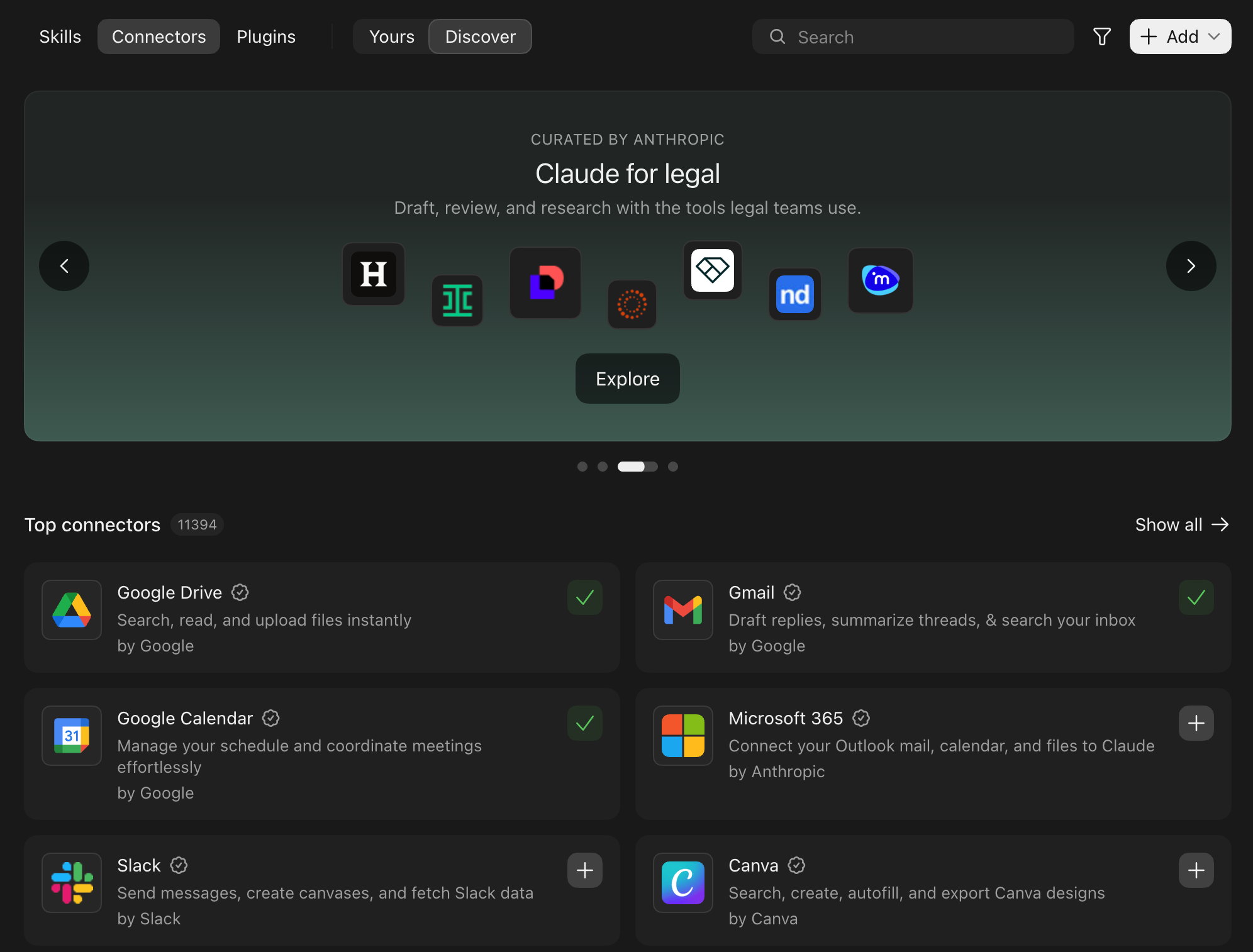
I use connectors every day. My AI is connected to Notion, Google Drive, and my spreadsheets, and most mornings I ask it to check what’s there and come back with whatever needs my attention.
The same thing works for your expertise. Instead of connecting their AI to Gmail, your clients connect it to your material: your frameworks, your posts, your checklists, the way you’d answer their question. They add it once, usually by pasting one link. From then on, when they ask their AI something you know about, it can go to your material for the answer and apply it to their own situation.
Here’s mine. In October I turned my newsletter, AI Maker, into an MCP and gave it to every paid subscriber. A reader’s AI can:
Run my 18 skills on their own work, from turning messy notes into content to preparing for the workday
Search nearly 200 of my posts, answer from them, and point to the post the answer came from
Pull from more than 120 prompts and questions I’ve written for thinking through decisions, plans, and stuck problems
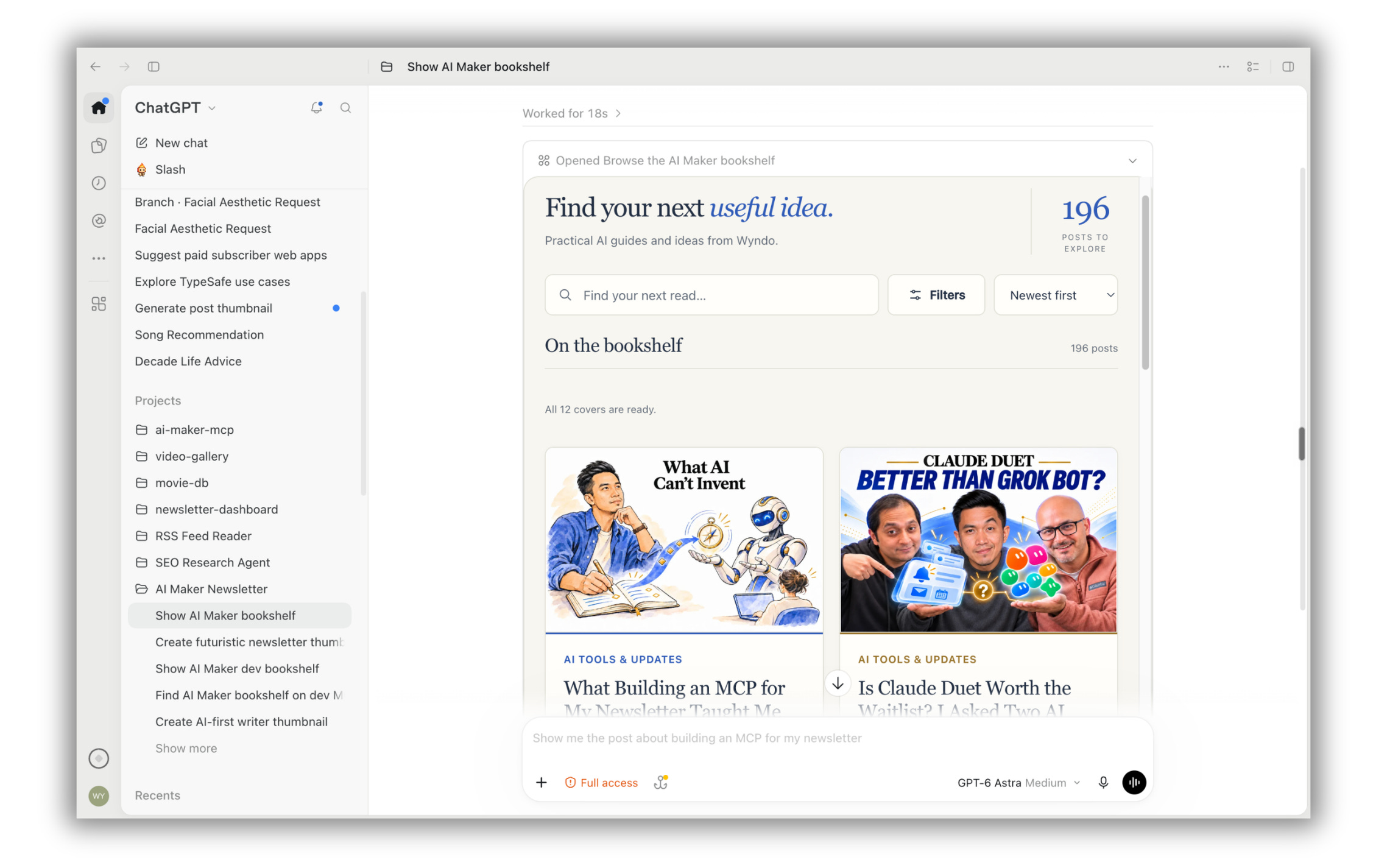
Hundreds of my paid subscribers have used it. Roughly 70 to 80 people a day search it, and that number is rapidly growing.
If you want your clients or customers to add your MCP, it only takes a minute. All they need to do is click one link, log in, and they can immediately access whatever content you’ve provided just for them.
What a tested skill does that your AI won’t do by itself
The skills are the part I think is worth paying for, because they do real work on the your client’s own material. Here’s one example, so you can see what goes into it.
Ask Claude or ChatGPT to review your sales page with no reference, and you’ll usually get the standard advice: add urgency, add testimonials, use specific numbers. That sounds right, and it can get you in trouble. If you don’t have a real deadline or a real customer quote, following that advice means putting yourself at risk by making one up. And typically, the AI’s answer is generic, leaving you confused about what to do and how to implement it properly.
But what if you know you have a unique expertise—where you understand more than a typical AI agent—and you use that knowledge to create a more effective way to review a sales page?
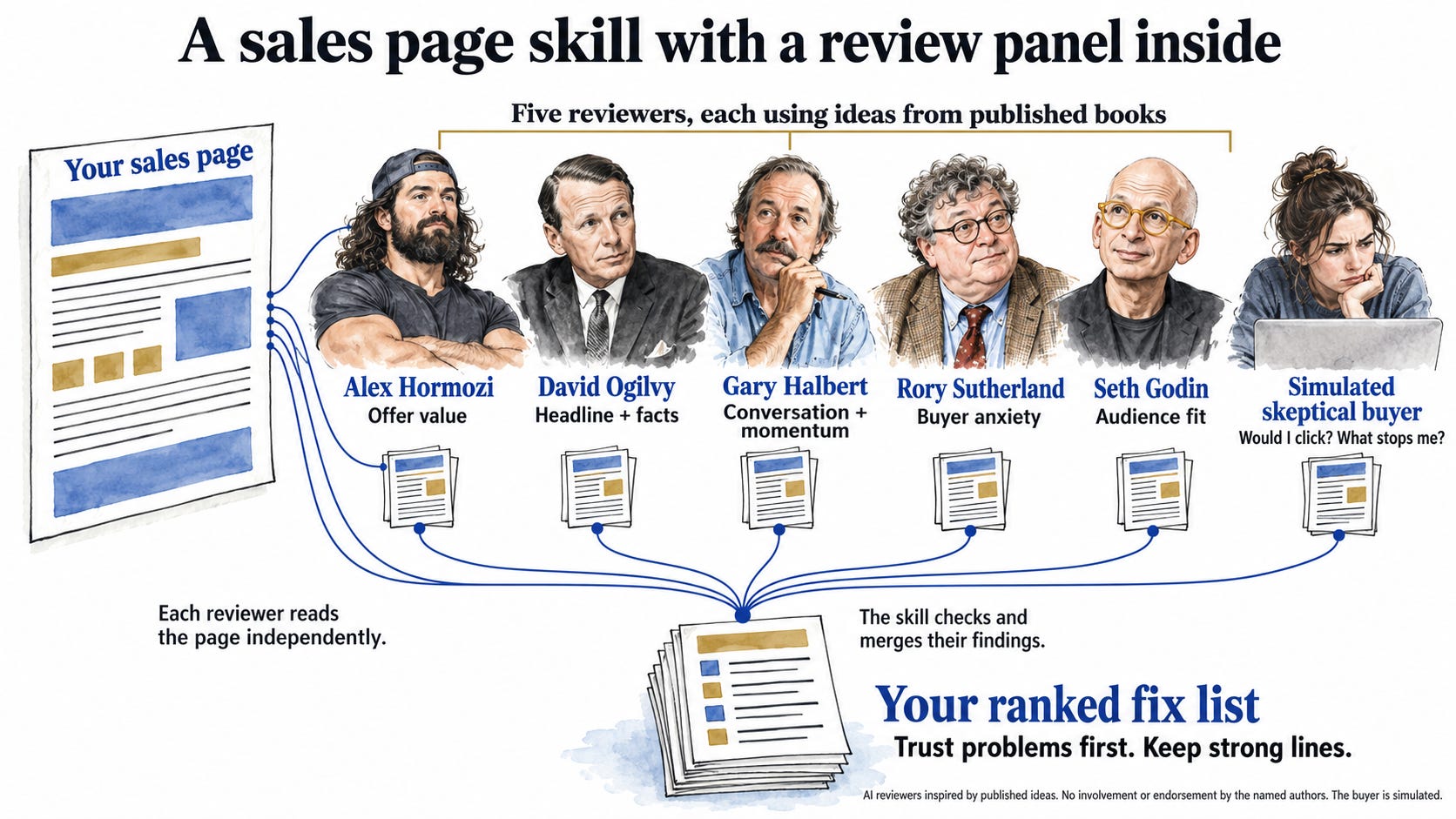
That’s what I did with MCP, where I let my subscribers use my Sales Page Builder skill so they can review their own pages. Here’s how it works, in this order, when you use it through Claude or ChatGPT:
It interviews you about your offer and writes an offer brief: what you sell, who it’s for, and what proof you actually have. It won’t write a fact that isn’t in that brief.
Your AI will open web pages, it reads your page the way a visitor sees it, on a laptop screen and on a phone.
It checks every claim on the page, every number, quote, deadline, and promise, and marks each one as backed up, out of date, or unsupported.
Six subagents that act as reviewers read the page separately. Five apply the published principles of well-known marketers: Hormozi on whether the offer is worth the price, Ogilvy on headlines and facts, Halbert on whether it reads like one person writing to another, Sutherland on what makes a buyer nervous, and Godin on who it’s for. The sixth plays a skeptical buyer and sees only what a real visitor would know.
It ranks the top five fixes, starting with anything untrue or broken, then rewrites the copy using only facts you gave it.
You could get pieces of this from a plain AI, if you knew to ask for every step, every time. But that requires deep knowledge of sales, while the skill turns that knowledge into instructions the AI can follow and execute for you, in the order that actually matters.
Here are some other skills I built for my paid subscribers that help them make better decisions, improve their writing drafts, and surface what’s most important in their meetings:
Strategic Decision Framework weighs a business decision using evidence, spelled-out assumptions, and a few strategy lenses, and ends with a next step you can undo if it turns out wrong.
Draft Review Panel reviews a draft from several perspectives, settles where the advice conflicts, and gives you one ranked list of fixes tied to the passages.
Meeting Decisions reads your meeting notes or transcripts and pulls out what was agreed, who committed to what, and what’s still open, with the line each one came from.
Your version of this is the review, diagnostic, or plan you already run with clients and customers. You write it down as steps, test it on real work, and share it with them so they can use it with their own cases.
Why now
MCPs have been around for two years. But, it’s only in the past few months that they got easy enough for someone who isn’t technical to make one and use one:
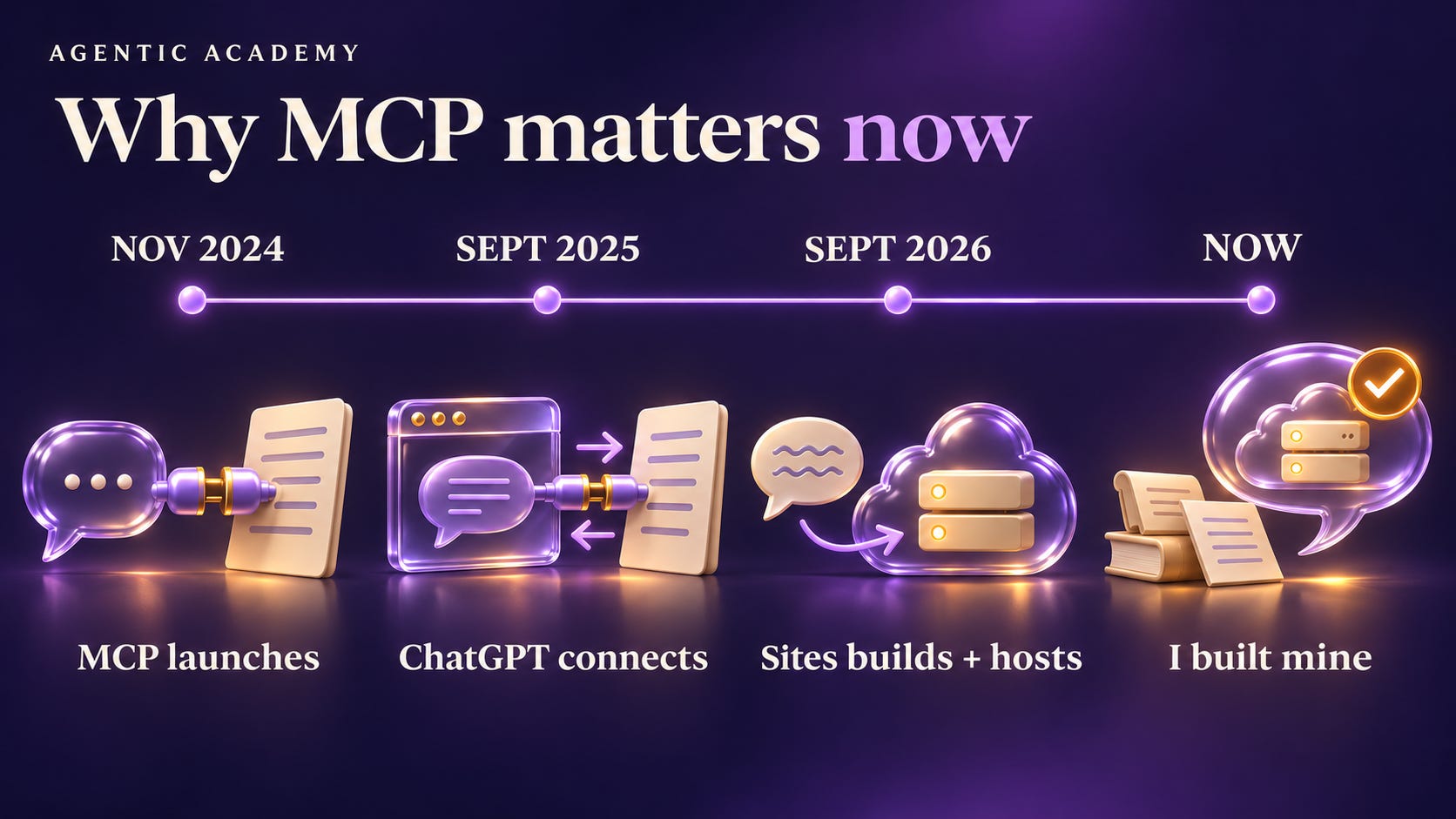
November 25, 2024: Anthropic releases MCP, and Claude can use it.
September 2025: ChatGPT adds full MCP support in a beta setting called Developer Mode, for Plus and Pro users on the web.
September 30, 2026: OpenAI announces that ChatGPT Sites can build and host an MCP from a single request.
Now: you can describe what you want to Claude Code, Anthropic’s AI that writes and runs code for you, and it builds the MCP and puts it online. That’s how I built mine. It runs on Cloudflare, a service that keeps it online, and Claude Code did the technical parts.
Big software companies are making the same move.
To follow it, you need to know one more term: API. An API is the door one piece of software uses to talk to another, with no person clicking through screens. When a booking site shows you flights from twenty airlines, what’s really happening behind the scenes is that each airline’s API is talking to the others. An MCP is a door built for AI assistants in particular, so Claude or ChatGPT knows what’s behind it and how to use it.
In April, Salesforce opened its entire platform, Slack included, to AI agents through APIs, MCP, and the command line. Marc Benioff summed it up as “Our API is the UI.”

Two weeks later, Box CEO Aaron Levie took the idea further. Levie’s argument is that as agents become the biggest users of software, every product has to work without its interface, because agents will talk to the APIs and skip the screens.

And a recent post by Nicolas Bustamante from the Microsoft AI team really nailed this where most SaaS should become an MCP server:

Look, this doesn’t mean you need to build a SaaS company. But it does show where AI is going and how we’ll interact with external data and apps in the future, including the unique domain expertise you can offer your clients and customers.
Rather than us going to websites, our AIs will use connectors like APIs and MCPs to access the IP (Intellectual Property) of companies (data, skills, etc).
Why I’d build an MCP before a prompt, a skill, or an app
By now, you might be asking: why an MCP?
Here’s where we are. AI is becoming the middleman between you and your clients. They ask it first, and it can already hand them the how-to from your book or course in seconds. Tim Ferriss’s sales show what that does to information products. Selling a course, a PDF, or a template on its own is getting harder.
So the question becomes how to package what you know so their AI can reach it and use it with them.
An MCP is one way to do that, and there are others. You could sell a prompt people paste into their chat. You could sell a skill they add to Claude or ChatGPT. You could build your own app with AI inside it. All three can work.
But, I’d still start with an MCP. When you’re selling expertise, these three questions will tell you why is it the right fit.
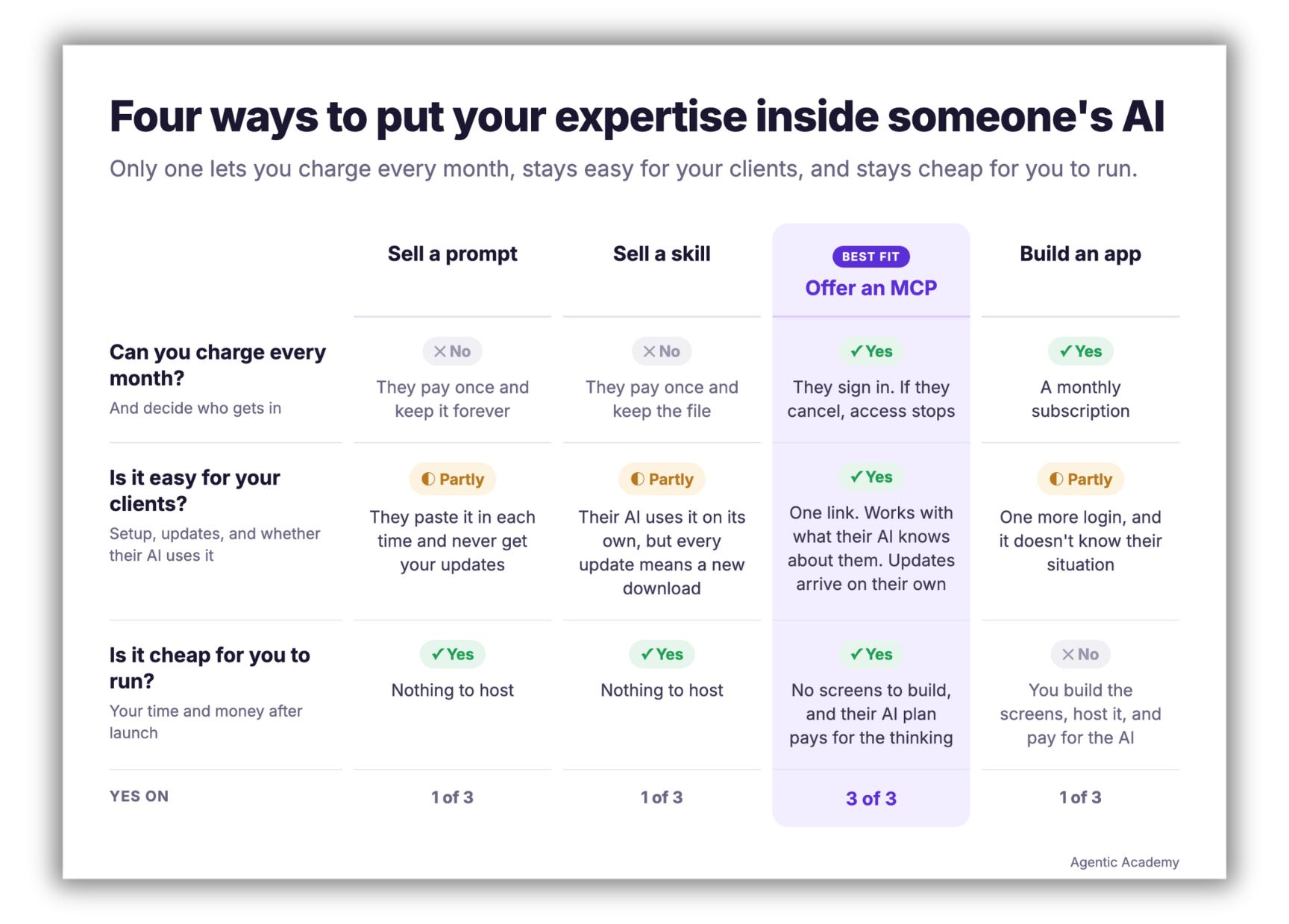
Can you charge every month? If I sell you a prompt or a skill, you pay once and keep it forever. An MCP can ask for a sign-in, so only the clients you approve or the people who pay you can use it, and when someone cancels, their access is switched off automatically. You have total control how you can monetize your expertise.
Is it easy for your clients to access and use? They add one link, and their AI uses it on its own when the topic comes up. It works with what their AI already knows from past chats, so your judgment meets their situation without them explaining it from scratch. And when I add a skill or a post, subscribers get it without reinstalling anything.
Is it cheap for you to run? An app can charge monthly too, but you’d have to build the screens or UIs, host it, and, if it runs on AI, pay for every question people ask it. An MCP has no screens to build, and their own AI plan pays for accessing it.
Three ways an MCP makes money
Let’s explore three ways you can start building MCP to turn your unique domain expertise into something your clients and customers can buy and access. Each of these starts with a skill, built through your judgment and written down so their AI can run it. MCP is how you deliver it and charge for it:
1. Run your process on their work
Say you’re an editor, a career coach, or a consultant with a review process. You have a checklist in your head for what makes a draft, a CV, or a plan good. Turned into a skill inside your MCP, that checklist runs on your client’s work in their own AI, before it reaches you.
Once their AI has a skill, it uses it whenever the topic comes up, and they don’t have to remember to ask. It’s like having a senior employee do the first pass, so you supervise less.
My Sales Page Builder skill, the one I walked through above, is this way in practice.
The math for you: sell your review skill as an add-on. Clients bring you their second draft instead of their first, so each review takes you less time, and you can take on more clients. Or sell it on its own: 40 people at $20 a month is $800 a month.
2. Your diagnostic, running between calls
Say you’re a business coach with a diagnostic you run when a client’s launch stalls. Today, that only happens on a call. With an MCP, your client asks Claude “why did my launch underperform?” and it takes them through your questions, in your order, using their own numbers. When the problem needs you, it suggests booking a call.
Here’s what that looks like with mine. I asked Claude, with the AI Maker MCP connected:
“Using The AI Maker, I’m deciding whether to launch a paid community for my newsletter or keep everything free. Help me think it through.”
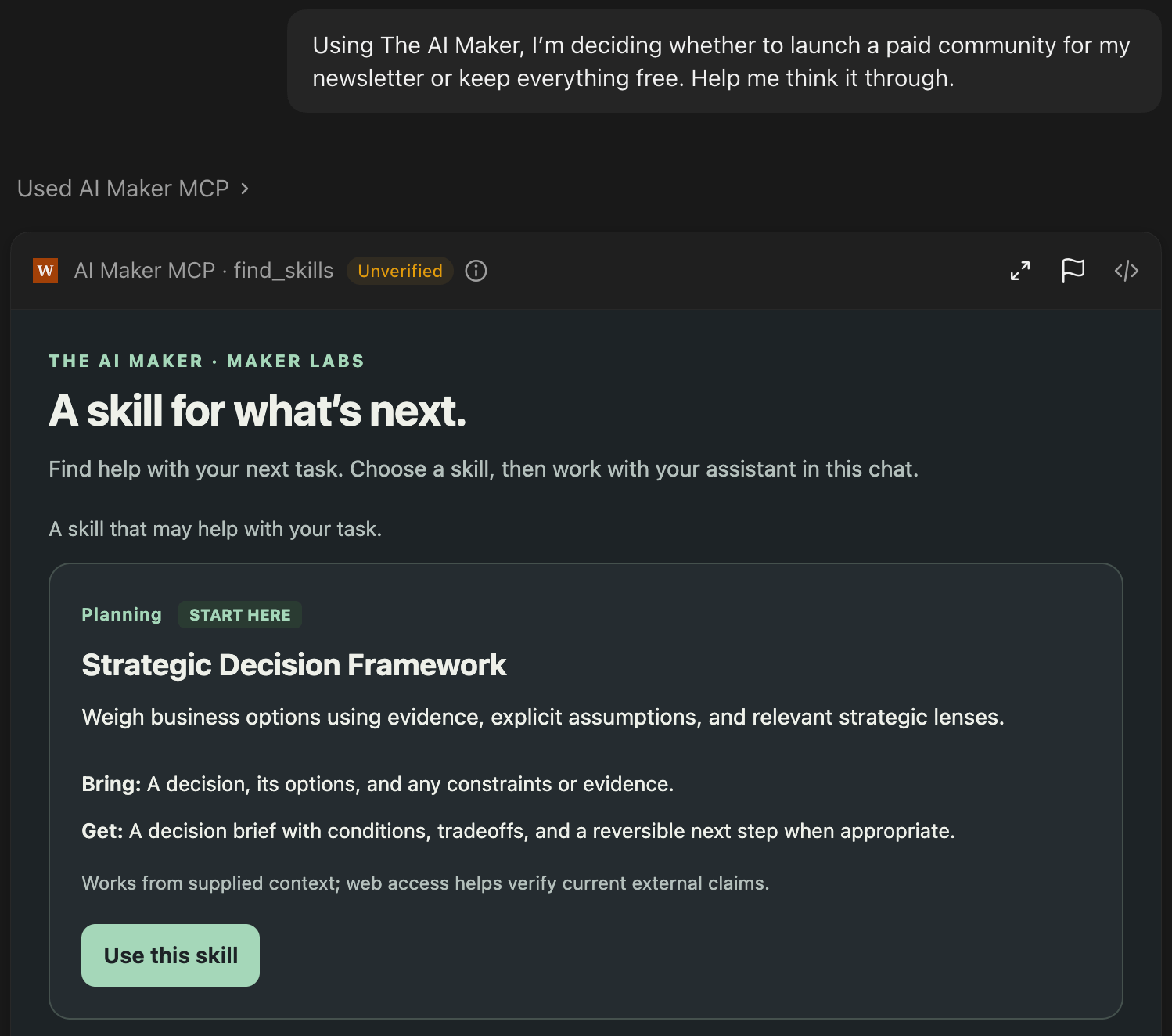
It picked my “Strategy Decision Framework” skill, which helps my subscribers weigh business options using evidence, explicit assumptions, and relevant strategic lenses.
The math for you: say you charge $150 an hour for a call. If 15 of your current clients pay $50 a month to have your diagnostic in their AI between calls, that’s $750 a month from work you’ve already done without you having to jump calls. It doesn’t replace your calls. Clients who’ve already worked through your questions come to the call with sharper problems, and the AI points them back to you when they need a person.
3. A reason members keep paying
Say you run a paid community or a course. Members join, engage for a few weeks, and then some forget it even exists. Most people don’t have time to log into your paid community or course because they spend most of their time inside their AI.
An MCP puts your membership inside the AI your members already open every day. A member asks:
“What has Wyndo written about using NotebookLM for research?”
And gets the posts that fit, the passages that answer the question, and a link to each one. Or they ask for everything I published last month and catch up in one answer, without opening Substack.
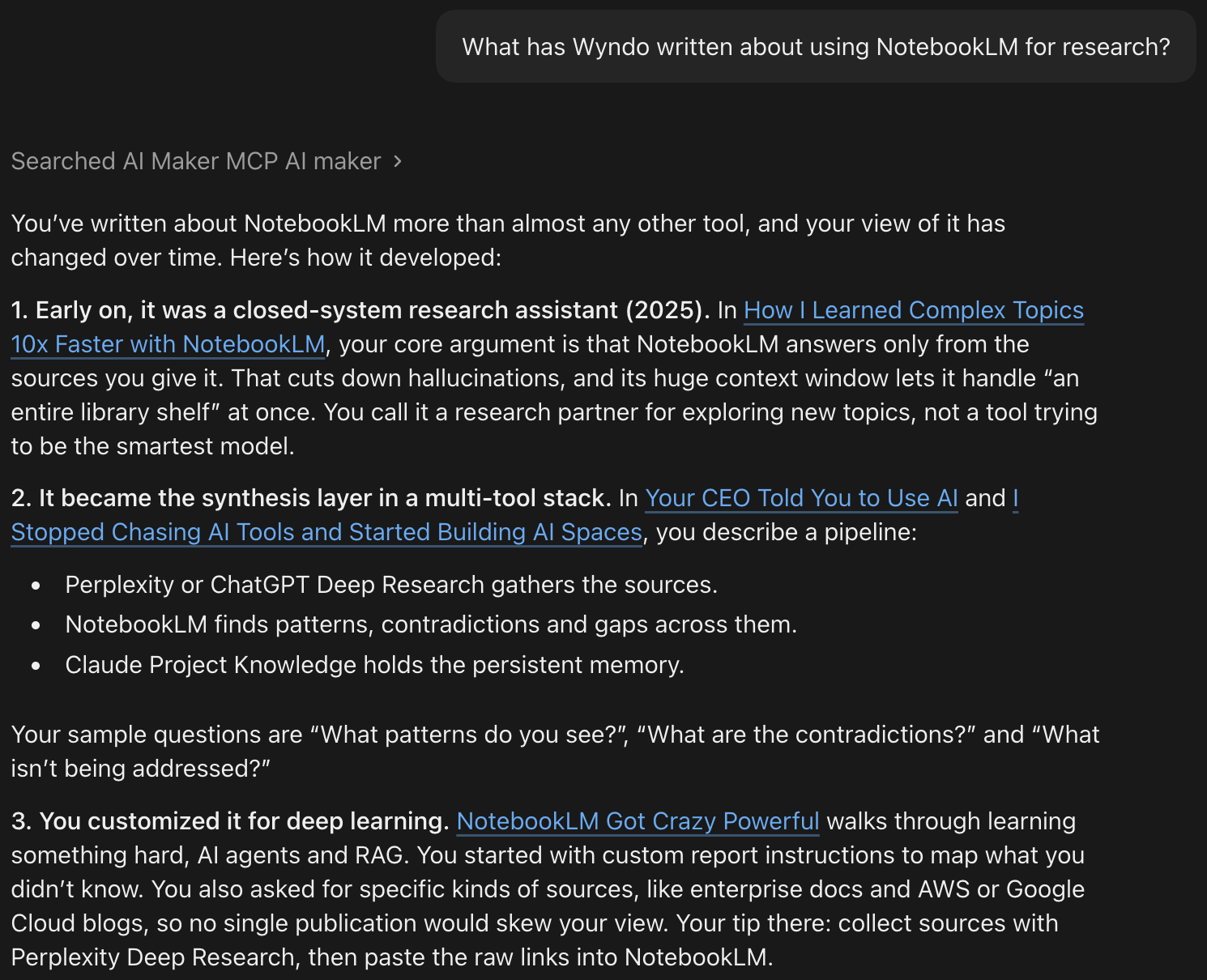
Search is what gets members to open it. I’d expect the skills to be what keeps them, because they save time on real work every week.
Lenny Rachitsky, whose newsletter has more than a million subscribers, already does this at scale. His paid subscribers get an MCP that searches 375 of his newsletter posts and 324 podcast transcripts from Claude and other AI tools, with a sign-in by email. Free subscribers get a smaller starter version through his Github repo.
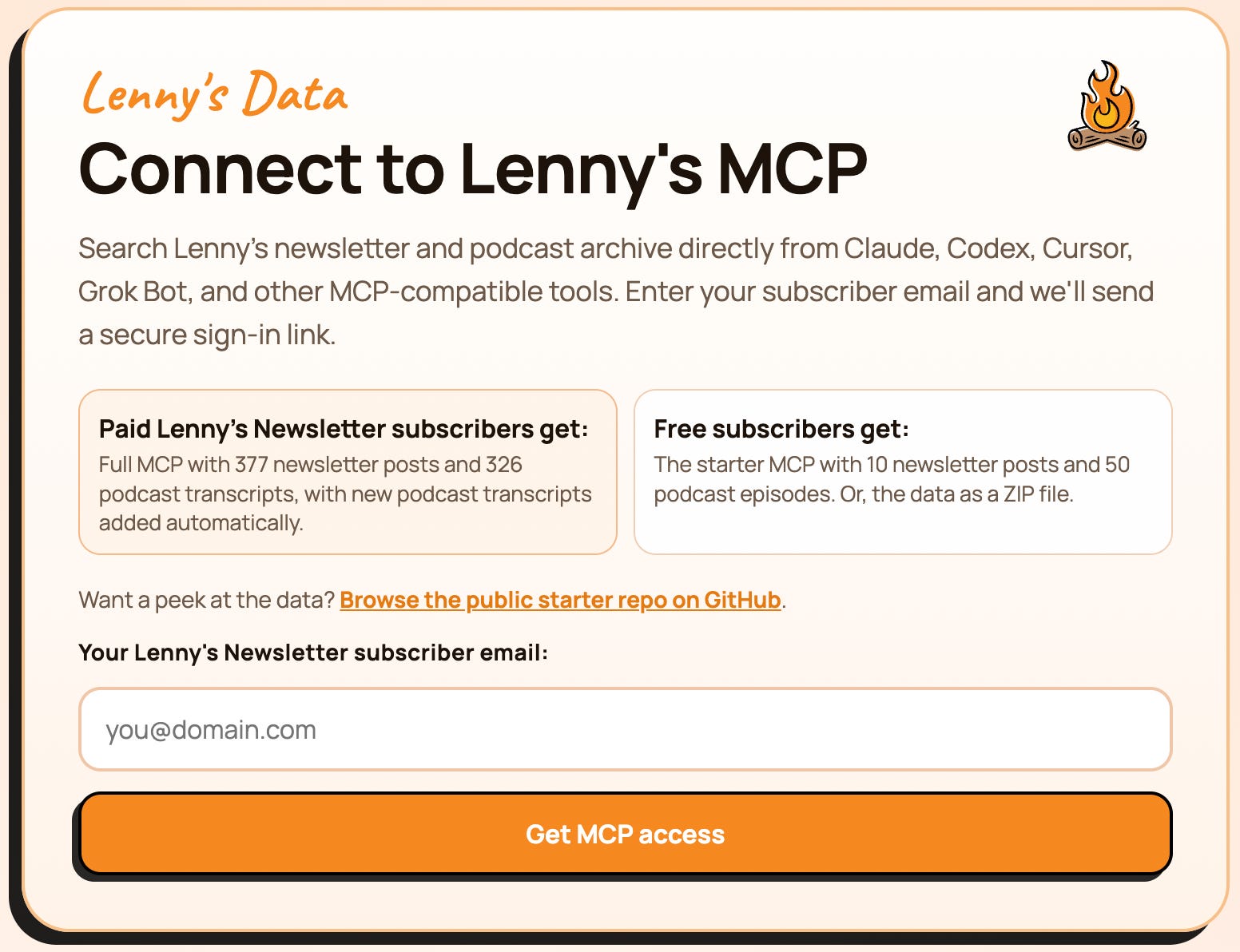
The math for you: if you have 200 members at $30 a month and an MCP can improve your member retention, then keeping just 10 more members each month than you’d otherwise retain is an extra $300 per month—and that number compounds as those members stay.
Where to start: if you already have paying clients, I’d start with the first or second way as an add-on for them. You know exactly who would use it, what kinds of questions they would ask, and how it can help them in their work.
Your quick win this week: one skill
You don’t need an MCP on day one. Start with the smallest piece: one skill that holds one piece of your judgment.
Pick a critical business or life question clients or customers ask you most where your honest answer starts with “it depends.”
Gather what you already have on it in one folder: notes, frameworks, emails where you answered a client, a call transcript. Leave out names and private details.
Ask your AI to turn it into a skill. Paste this into Claude or ChatGPT with the folder attached:
“I’m [what you do]. The question clients ask me most is [the question]. Using the files I’ve attached, write down how I actually decide the answer: the questions I ask first, what changes my answer, and the mistakes I see most. Turn that into a skill another AI could follow to answer this question my way. Then tell me what you’re least sure about, and ask me those questions before you finish.”
Test it on a real question from this week. Save it as a skill in Claude, or in a ChatGPT Project, and ask it the last version of that question a client sent you, with names removed. If the answer sounds generic, tell it what you’d have said instead and ask it to update the skill.
That skill is the first thing that goes inside your MCP. The next step is putting it behind a sign-in and charging for it.
Join us on November 27 to build your MCP at our Bootcamp
On Friday, November 27, 11:00am to 2:00pm ET, live on Zoom, Michael and I walk you through building your first MCP from your own material.
You could teach yourself all of this. What takes the longest is the part between “I have a folder of notes” and “a client signed in and paid,” and that’s what we do with you live.
Our skill for the session called /mcp-expertise does most of the work with you:
It reads your folder (files, PDFs, templates, etc) and interviews you, one question at a time, about what people pay you for and where you say “it depends.”
It recommends what to build, argues against its own pick, and waits for your OK.
It builds your MCP and puts it online on your own Cloudflare account, with a sign-in so only the people you approve, or the people who pay you, can use it. It sets up Stripe, the payment service, in test mode, so you can try a purchase before real clients/customers pay you.
You’ll leave with:
Your own MCP, online, with a sign-in and a link you can give your clients
Stripe ready to switch to real payments
The
/mcp-expertiseskill, to help you build your MCPThe recording, transcript, and full resources
You’ll need:
A folder of your material (the one from the quick win works)
A paid Claude plan with Claude Code in the Claude desktop app. The $20 Pro plan works to start; we recommend the $100 Max plan because you’ll build a lot during the session. ChatGPT works too!
A free Cloudflare account and a Stripe account.
Do I need to know how to code? No. You describe what you want in plain English, and Claude Code writes and runs the code. You approve the account steps.
We teach these sessions for people who use AI but aren’t technical.
How to join
November 27 session only: $500. The live 3-hour session, the skill, and the recording and full resources. You can upgrade to the full year later for $2,250.
Year-long Mastermind: $2,500, or 6 monthly payments of $500. This session plus the rest of the year’s monthly sessions (12 in total, through September 2027), Build Clinics, replays of our October sessions, a monthly Show & Tell, and our WhatsApp community.
Paid subscribers of AI Maker or Michael’s newsletter, Blockbuster Blueprint, take $150 off either one. Get your code, either from me or Michael:
If it doesn’t work for you: build your first version with what you learned within 30 days. If you don’t, email support@thoughtleader.school within those 30 days for a full refund. If you’re on the payment plan, we refund what you’ve paid and cancel the rest.
Doors close when the session starts: Friday, November 27, at 11:00am ET.
The AI your clients use is going to answer a lot of their questions. On November 27, we’ll help you make sure some of those answers come from you.
See you on the 27th.
Wyndo