

I’ve spent the last three years going all-in on AI as a learner, writer, and builder.
Yet, my own teenage daughter thinks I’m on the wrong side of history.
She isn’t a Luddite either. She’s just looking around as:
Her generation gets hollowed out by social media addiction
The same tech industry promises it’ll save us with something more powerful.
Stories of sexual deepfakes of women and children spread.
Her peers use AI to cheat their way through school.
Environmental damage from data centers is increasing.
AI companies illegally steal the intellectual property of creatives.
The future job market disappears faster than anyone is willing to admit.
My son isn’t angry like she is. He’s indifferent. The technology that’s reorganizing the global economy doesn’t seem worth his attention.
I assumed I’d talk them out of it.
And boy did I try.
I opined on the opportunities, the ease of getting started, and the importance of moving early.
But the more I talked, the more I realized I was the one being lectured. My daughter wasn’t repeating talking points. She was describing a world she lives in that I don’t.
What I now see is that they have grown up in a completely different reality from mine.
When I was a teenager, I read inspiring magazine cover stories about entrepreneurs like Steve Jobs, Richard Branson, Bill Gates, and Jeff Bezos.
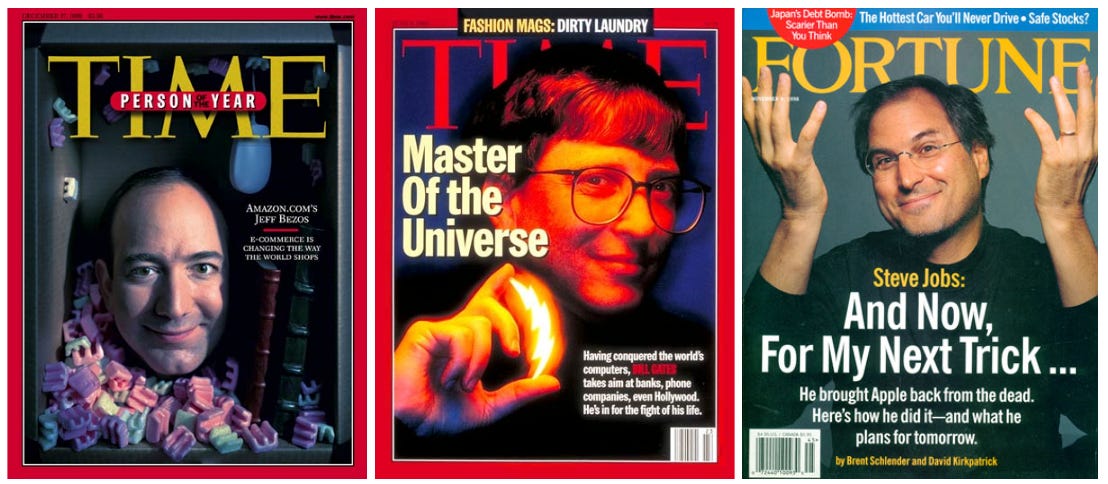
These stories of young people making it big and changing the world inspired me to co-found a business.
My kids grew up with the inverse:
Elon Musk’s rants on X.
Allegations about Bill Gates and Jeffrey Epstein.
A decade of tech in the form of social media rotting their friends’ attention spans.
A generation of parents losing middle-class footing despite doing everything right.
Mind-boggling wealth concentration:
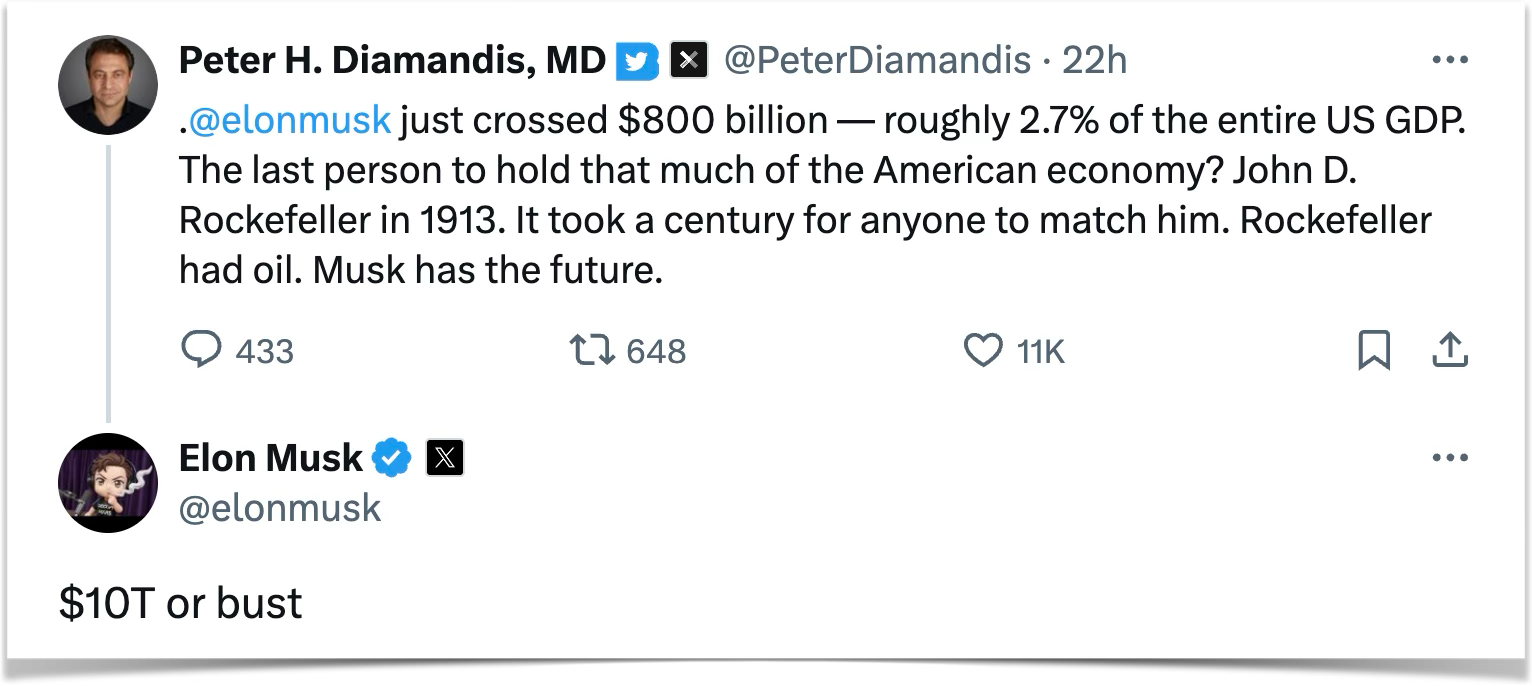
For me, the arrow of the future pointed up. For my kids, it points into oblivion. A fast-changing alien future no one can see.
So I stopped trying to convince them and started trying to understand them. I spent the next several months reading the research on AI and young people.
What I found is worse than I expected. And it’s worse than almost anyone in my industry is willing to say out loud.
This essay is what I learned, why I think the people building AI are systematically refusing to look at it, and what my daughter saw that I didn’t…
My Kids Aren’t Alone
A quote from an April 2026 Gallup poll of 1,500 young people captures the situation:
“Gen Z’s sentiment toward AI has become significantly more negative…”
This table, based on the poll, shows the magnitude of the one-year sentiment shift:
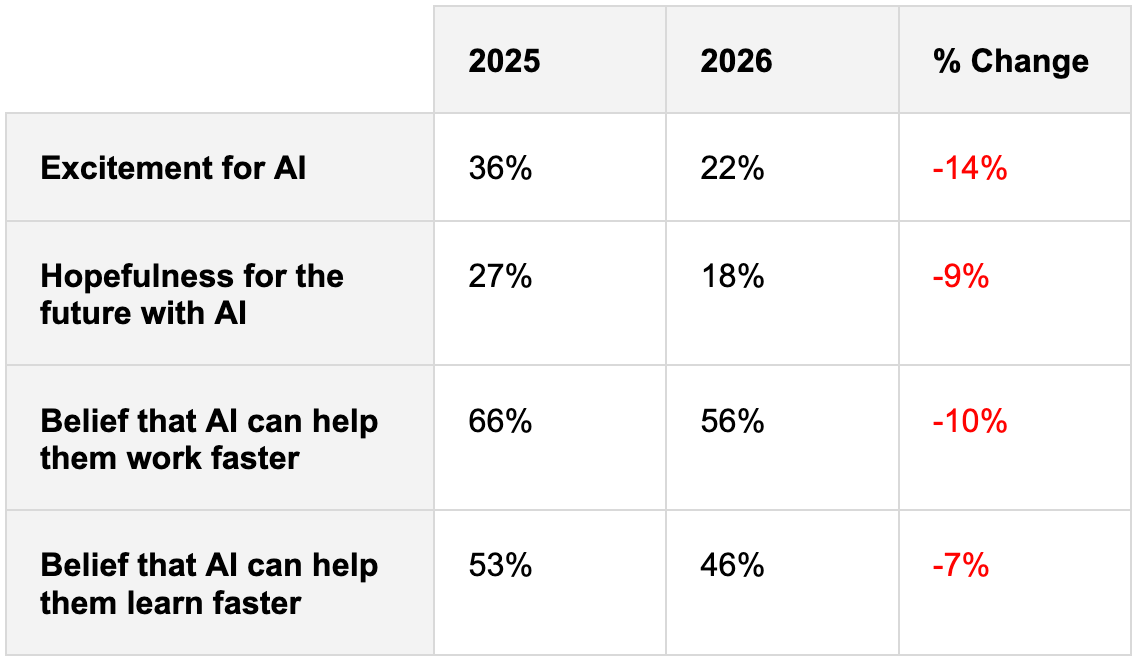
These stats are astounding when you think about them…
Young people are typically the most excited about new technologies. This generation isn’t.
As AI gets better, you’d think young people would expect AI to make them more productive. They think the opposite.
These effects could skyrocket as we’re still at the beginning of the AI explosion.
After doing a lot of research, I now believe two seemingly opposite ideas are both true:
The near future will be awesome for select young people. The 5% most entrepreneurial young people will do better than any previous generation. They will learn AI on their own and build bigger businesses faster. In a fascinating tweet, the CEO of Y Combinator, the largest startup accelerator in the world, recently shared that 3X more companies in their latest 3-month batch hit $1M in annualized revenue compared to the previous cohort.
The near future for most young people will suck. The 95% who aren’t entrepreneurial or going into blue-collar work will have a very tumultuous and uncertain beginning to their career. Many will graduate with record college debt and a cost of living that’s higher than ever. 64% will move back in with their parents.
These two groups seem to be completely talking past each other.
Every single AI podcast I listen to enthuses about the immense opportunities for young entrepreneurs. Sam Altman says there has never been a better time for a young person to start a business.
Yet, what is left unacknowledged is that only a minuscule percent of the population has the desire and inclination to actually start a successful business—even with entrepreneurship education. And, I should know because I spent most of my career in that field.
But before I jump deeper into the research, it’s critical to understand what’s at stake here for us all…
Why Young People And AI Matter
“The future is already here—it’s just not evenly distributed.”
—William Gibson
The future doesn’t happen overnight out of nowhere.
It happens gradually in the hidden fringes as small trends go mainstream.
Therefore, one of the most reliable ways to make educated predictions about the future is simply to find where the future is already happening.
Coding is the canary in the coal mine. It's the field AI has hit hardest and earliest, and the patterns showing up there now will spread across knowledge work within a year. Watch the canary, and you get a year's head start on your own field.
Similarly, young people are a canary generation.
They give us our first glimpse of how AI may impact all knowledge workers over the next 3-5 years.
More so, the implications go beyond economics into politics.
In 2010, complexity scientist Peter Turchin published a viral study in Nature. He used a mathematical model of state collapse based on historical data to predict that the United States and Western Europe were heading into a decade of political instability around 2020. He was right. And the variable he identified as most predictive wasn’t inequality, or polarization, or media fragmentation. It was the “overproduction of young elites.” He particularly made this point in his 2023 book, End Times:
“Overproduction of youth with advanced degrees has been the most significant factor driving societal upheavals, from the Revolutions of 1848 to the Arab Spring of 2011.”
Given these stakes, the research findings so far are particularly important to pay attention to…
The Research Is Already Here, and It’s Troubling
In August 2025, Erik Brynjolfsson, the Stanford economist, published what may be the most important empirical paper on AI and employment to date. The study, Canaries in the Coal Mine?, uses payroll data from ADP covering millions of workers across tens of thousands of firms.
Since AI tools became widespread, companies have sharply cut hiring of young knowledge workers:
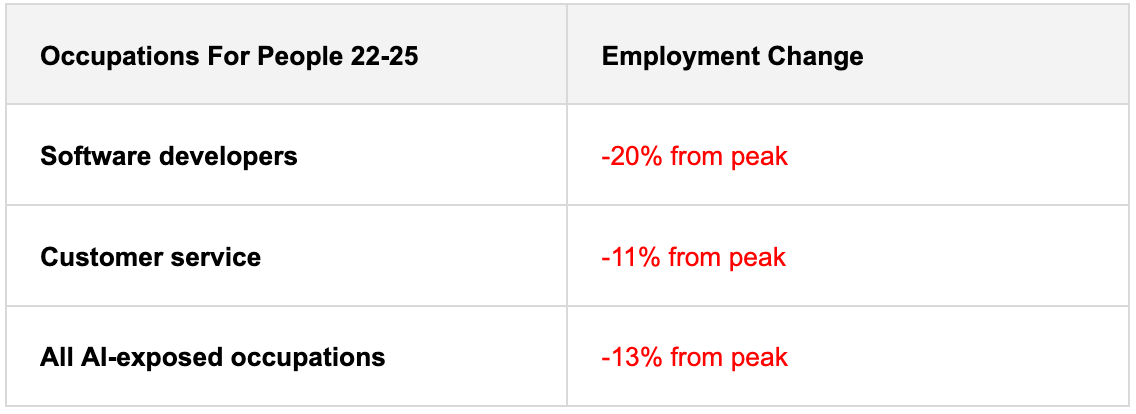
While experienced workers in the same roles have been largely unaffected:

There’s one important caveat, though.
Brynjolfsson’s paper is careful to note that post-pandemic tech hiring corrections, interest rate changes, and the unwinding of 2021-2022 overhiring all played a role in the drop, too.
So he conducted a follow-up study that tested alternative explanations (interest rates, post-pandemic correction, tech overhiring) and found that the AI effect only grew stronger.
Bottom line:
AI is adding intense pressure to young knowledge workers.
Despite this pressure on an entire generation, there is something odd that’s making it easy to ignore…
The Quiet Crisis
This emerging crisis did not arrive in a televised crash, or a market panic, or a single announcement from a large company saying the old bargain was over. It has arrived more quietly:
A job posting did not appear.
An internship class got smaller.
A manager decided not to hire a new person after another retired.
From inside, the situation feels stable. If you already have a good job, your paycheck arrives. Your team is busy. The economy appears healthy. But if you are trying to enter the workplace, the same condition feels like a wall.
A full hotel looks successful to the owner and hopeless to the person outside with a suitcase.
Young people are the ones with the suitcase.
Not only that, the crisis is quiet on another level, because of how the metrics are measured.
Let’s say a recent computer science grad applies for lots of programming jobs, but doesn’t get hired. As a result, she decides to work in retail while applying for more software roles.
The data says she is employed.
It doesn’t say she is an unemployed programmer.
Multiply her situation by hundreds of thousands of more young people.
Bottom line:
Our statistics are based on the jobs people have held. They’re much less good at measuring the jobs people were prevented from starting.
How AI Breaks The Bottom Rung Of The Career Ladder
When I first saw the Brynjolfsson data, I thought the story was just about AI replacing junior workers.
That’s how most people are framing it.
But there’s something more profound happening here.
Historically, new technologies have hit experienced workers hardest. A study from MIT Sloan and Northwestern’s Kellogg School that tracked technology displacement across occupations from 1981 to 2016 found that when new tools could perform tasks in place of workers, all affected workers suffered wage losses. Younger workers, with less invested in now-obsolete skills, typically adapted faster.
But Brynjolfsson found that experienced workers in the same AI-exposed occupations didn’t decline. They stayed stable, or grew. This moment is unique in tech history because AI is replacing beginners, not veterans. It’s amplifying experiential expertise.
And the implications for all of us are more alarming than most people realize.
Here’s how work used to function:
Step #1: Junior workers supplied codified knowledge. From college, they knew the rules, methods, syntax, research process, spreadsheet techniques, case law search, and coding patterns. They weren’t yet wise, but they could produce useful first passes.
Step #2: Junior workers gain judgment via experience. That usefulness bought them a seat inside companies where they could observe experienced people making real decisions. Over time, through that proximity, they acquired something much harder to teach: judgment.
Simple. Right?
Here’s the issue, though:
AI replaces the codified knowledge of young people. It can draft, summarize, classify, scaffold, translate, synthesize, generate options, and imitate formats.
AI magnifies those with experience. Senior workers know what questions should be asked. They know what answer is suspicious. They know when a technically correct solution fails socially, legally, operationally, or morally. They know which facts matter and which are decoration.
Brynjolfsson puts the situation plainly in an interview with Derek Thompson:
“LLMs learn from what’s written down and codified, like books, articles, Reddit, the internet. There’s overlap between what young workers learn in classrooms, like at Stanford, and what LLMs can replicate. Senior workers rely more on tacit knowledge, which is the tips and tricks of the trade that aren’t written down.”
That’s the mechanism. And it creates a reinforcing loop with no natural brake:
Better AI.
Senior employees become more productive with AI.
Fewer juniors are needed.
Fewer juniors are hired.
Bottom line:
AI isn’t replacing experienced workers. It’s replacing the training process that creates them.
At which point, a problematic situation activates.
Entry-level work was never just about production. It was the mechanism by which tacit knowledge was transferred across generations.
The senior engineer didn’t just produce output. He was also training the next generation. Therefore, when firms cut junior hiring, they’re cutting their own training function. They just don’t notice it yet, because the training was invisible. It was embedded in the work itself.
I have on multiple occasions produced output with AI that I would have previously estimated would take weeks of work. I am the direct beneficiary of the productivity amplification that feeds the loop. That’s exactly why I find it so alarming. Because I can feel, from the inside, how rational it is for every individual organization to do this. And how catastrophic it becomes when everyone does it simultaneously.
The market sees today’s productivity. It does not automatically price tomorrow’s missing apprenticeship.
We are removing the tasks that train judgment because AI can perform the tasks before judgment forms.
The senior employees who hold that judgment today will eventually retire. And when they do, we will discover what it costs to have skipped a generation of training.
Every Door Closed at Once
Previous automation waves were painful but more navigable.
Factory automation closed manufacturing entry-level jobs, but opened IT, maintenance, and service positions.
Computerization eliminated clerical roles but created software, networking, and digital marketing jobs.
In every case, one set of entry points closed while another set opened.
There was always somewhere else to go. The transition might have required retraining, relocating, or starting over at the bottom of a new, promising field. But at least the new field existed.
AI will certainly create new jobs. But AI is doing something no previous technology has ever done. It’s closing entry points across most types of knowledge work simultaneously.
The same technology that automates junior coding automates junior legal research. It automates junior financial analysis, junior marketing, junior journalism, junior consulting, and junior administration. The entry-level tasks across all of these fields share the same characteristics: they’re relatively well-defined, have clear success criteria, require broad but shallow knowledge, and produce outputs that can be evaluated by more experienced humans.
This is precisely the kind of work at which current AI excels.
No previous automation wave has ever moved this fast or hit this many industries at once, while there were so few new jobs to turn to.
And the cruelest part? The social contract around education is breaking at the same time.
For decades, the deal was simple:
Go to college
Acquire skills and credentials
Get a professional job
Pay off your loans
Build a life
That contract is embedded in every aspect of a child’s life:
Parental expectations.
High school guidance counseling.
Student loan structures.
It is the entire architecture of how we organize the transition from adolescence to adulthood.
AI is breaking this contract in a very specific and damaging way. It simultaneously reduces the value of credentials while maintaining credential requirements and increasing credential costs.
A computer science degree means less as a hiring signal because AI can write functional code. But companies still require it, because hiring practices change slower than technology.
And right now, student debt in the United States exceeds $1.7 trillion. To put that in perspective: it’s more than the GDP of Australia. An entire wealthy nation’s worth of economic output, owed by young people who took on debt to buy access to a middle-class life.
Bottom line:
A 22-year-old graduating with a computer science degree and $87,000 in student debt is not a symbol of irresponsibility. She is a symbol of obedience.
She did the thing the culture asked of her. She chose the hard major. She listened when adults said the humanities were risky and technical skills were safe. She accepted debt because the debt was supposed to purchase access to the future.
That is what makes the story morally difficult. The advice was not stupid when it was given. In the world of 2018 or 2020 or even 2022, studying computer science looked like one of the most rational decisions a young person could make.
The world changed faster than the advice.
Now, instead of saying “Learn To Code”, the advice is “Learn AI.”
While I think this is good advice for professionals today, I’m not sure it’s the most practical advice for a 10-year-old. When that young person eventually graduates from college in 2038, AI might be doing almost all knowledge work faster and smarter than a human can even keep up with. 12 years in AI time is like 100 years in normal time.