

Editorial Note
This isn’t my usual article.
A few times a year, I come across an idea so big it changes my life. When that happens, I drop everything and go all out to make sure it lands with you the way it landed with me.
This is one of those.
What follows connects dots most people are missing. And, it takes you behind the scenes of a small group of knowledge workers at the frontier who are already 20x’ing their productivity.
This article went through 20+ drafts and is the culmination of 100+ hours of research. It’s years of tracking and thinking about AI condensed into one read.
Article
“Why are these people making the world so hard for me to live in? Everything worked fine before.”
My mom said this to me last year, and it sent a dagger into my heart. She is 74, retired, and was, I want to emphasize this, a computer engineer.
My mom is still the most independent-hearted person I’ve ever met, and I immediately knew what she was really saying. The shift was causing her to lose what she valued most: her independence.
The same pattern kept repeating:
Her old device would break (phone, TV)
She would get the new version, which was “smart” by default
The setup and usage would be overwhelming
She’d spend hours trying to figure out something that would take someone else minutes.
Until eventually, she’d either give up or get help.
With each new device that went “smart” and each offline process that went online, her independence eroded.
She did not see this coming. Almost nobody who gets left behind ever does. But the world was becoming more and more alien to her, and it felt like there was nothing she could do about it.
I’m writing this article because the same thing is about to happen again, on a drastically faster timeline, to a much larger group of people. And I think there’s a real chance that you’re one of them.
In fact, a huge percentage of people are already wondering the same thing about AI that my mom wondered about technology:
Why is this small group of people in Silicon Valley creating something that will completely disrupt my life, my plans for the future, my local community (in the case of data centers), and my decades of expertise that I’ve gone into debt for?
The resistance isn’t coming from where you’d expect either. This time it’s not just retirees struggling with new interfaces. Graduating seniors are booing commencement speakers for telling them to embrace AI. The people who would normally be most excited about the future are the angriest about it:
I resonate with the backlash.
Within two decades, AI may be orders of magnitude smarter, faster, and cheaper than any human worker, and there will be far more of it than there are of us. The downside scenarios are real.
But none of us get to opt out of the world we live in.
The knowledge workers who don’t embrace AI will be left behind, and no one is coming to bail them out. Those who embrace it will see their productivity shoot up to previously unfathomable levels.
But anger and excitement have one thing in common: neither one tells you what to do next…
The Most Dangerous Career Advice Right Now Is "Figure Out AI"
Everyone agrees AI is transforming the world. Almost nobody agrees on what that actually means for anyone’s career.
A clear, hopeful future has been replaced by fog. Now it’s hard to know whether AI will take all of our jobs in five years or just keep making us more productive and creative for the foreseeable future.
Therefore, it’s hard to know exactly what to do now. It’s hard to know which AI skills will pay off for years, and which will be obsolete by the time you finish learning them.
Many people are falling into one of two camps:
Opting out of staying on the AI frontier and burying their head in the sand.
Flailing around trying to do everything. Staying on top of the latest tools, AI models, AI harnesses, prompting techniques, and industry news. Working harder than ever, but not sure if they’re making real progress.
This article is about clarity.
It provides you with the one AI skill and the one category of tools that are virtually guaranteed to deliver the biggest return for knowledge workers who apply them.
This clarity is critical because once you know what won’t change, you know what to invest in now and can be confident it will pay off.
Not only that, based on Harvard research and early results of people who are making the switch (more on this later), I can confidently say that the skill you’ll need to learn is one that you’ll actually enjoy doing.
And if you haven't started yet, that doesn't mean you're behind. You're in Stage 2 of a 5-stage pattern. The window is still open.
Very few have felt the true magnitude and speed of what’s happening, because we’re all inside it. It’s so ever-present that it’s invisible. To really see it, you have to step outside of it.
This article will help you take that step outside.
The Multi-Century Pattern That Reshaped Civilization Twice Is Running A Third Time
In 1700, saying “I can’t read” carried no stigma. By 1900, it was a serious liability.
In 1990, “I don’t use computers” was a defensible position. By 2015, it ended careers.
Today, “I’m not a programmer” is normal. By 2030, it will sound the way “I can’t read” sounded in 1900.
I’m not predicting this flippantly.
We’re inside the third run of a historical pattern that has already reshaped civilization two and a half times:
Once for reading and writing (text literacy)
Once for counting and calculating (numerical literacy)
Finally, for using and authoring software (software literacy)
Just as reading literacy spread for centuries before writing literacy did, software usage (digital literacy) spread for decades before software authorship became mainstream.
Today, knowledge workers use dozens of software apps on their phones, in their browsers, and on their desktops. Someone who can’t use software is essentially unemployable as a knowledge worker.
Starting in November 2025, when AI agents became able to reliably create working code, we entered the second stage of the third literacy—Software Authorship —in which domain experts turn what they know into running systems using plain English, with AI doing the technical work.
On the surface, Software Authorship doesn’t sound like a civilizational shift on the scale of reading or arithmetic. For 50 years, software has been a niche specialty: built by highly paid engineers, used passively by everyone else. Calling it the next universal literacy feels like a stretch at first.
It isn’t.
On the surface, Software Authorship doesn’t seem likely to have much impact on the average knowledge worker’s day-to-day work and career trajectory.
It will.
On the surface, Software Authorship feels like the type of shift that will take decades to run its course.
It will likely take 5-10 years. Maybe less.
The shift will create a new generation of economic winners and losers:
Winners: On the one hand, the most advanced AI users creating software will be 100x, then 1,000x, and then 10,000x more productive than the average knowledge worker who lightly uses AI in chat. This is already happening, which I explain later in the article.
Losers: On the other hand, many people will be left behind. Way more and way faster than in any previous technological shift.
I see the tsunami coming, and 99% of people don’t recognize what’s about to happen. As a lifelong educator, my mission is to help people make this shift as smoothly as possible.
On a personal level, I feel motivated by both the opportunity and the risk:
Over the past few months, I’ve seen my productivity skyrocket higher than it’s been at any other point in my career.
I fear being left behind on a visceral level because my mom isn’t the only person I’ve watched be left behind in the past, and it’s brutal…
What Happens To The People Who Sit This One Out
A 2005 comment from a dear mentor still sticks with me:
“I used to be good at computers in the 80s. I shouldn’t have let my skill slip. Don’t make the same mistake I made.”
Earlier in his career, my mentor decided to be more productive by delegating technical tasks to his employees rather than learning them himself. Until one day, he woke up and realized four harsh truths:
He was completely dependent on others for basic tasks.
He had become the kind of person who got the warm handshake at the front of the room and the knowing look behind his back among employees.
He was losing contracts to others because he wasn’t keeping up with the times.
He was so far behind that he couldn’t catch up.
I remember one moment in my early 20s when he asked me for help with a very basic tech task. It felt so obvious, I couldn’t help but smirk. He paused, closely examined my face, and then immediately ended the interaction. He never asked me for tech help again.
Looking back, I see his vulnerability in asking for help and his shame at my response. I wish I could’ve responded differently.
He never did catch up.
My mom and my mentor weren’t stupid or lazy. On the contrary, during their careers, they were each ambitious and successful. They just didn’t develop a key universal literacy when they had the chance. And they didn’t realize what they’d lost until it was too late.
It’s the boiling frog problem. The water heats one degree at a time. The frog never feels the moment when it should jump out, until the moment when it can’t. AI is doing the same thing to most knowledge workers. Each new headline is interesting but not alarming. Each week, it still feels okay to start later. The water just gets a little hotter.
Realizing this, I started doing the one thing my mom and my mentor didn’t. In March 2023, I made the decision to focus on studying and writing about AI full-time.
Then last winter, my news feeds blew up…
I Spent Twenty Years Convinced I Wasn’t A Programmer. I Was Wrong.
I saw the most luminary programmers stop writing code all at once:
Given the latest lift in LLM coding capability, like many others I rapidly went from about 80% manual+autocomplete coding and 20% agents in November to 80% agent coding and 20% edits+touchups in December. i.e. I really am mostly programming in English now.
—Andrej Karpathy (former head of AI at Tesla), 40,000 likes
Pretty much 100% of our code is written by Claude Code + Opus 4.5. For me personally it has been 100% for two+ months now, I don’t even make small edits by hand. I shipped 22 PRs yesterday and 27 the day before, each one 100% written by Claude.
—Boris Cherny (head of Claude Code) on behalf of Anthropic’s team, 7,000 likes
programming always sucked. it was a requisite pain for ~everyone who wanted to manipulate computers into doing useful things and im glad it’s over. it’s amazing how quickly I’ve moved on and don’t miss even slightly. im resentful that computers didn’t always work this way. I 100%, I don’t write code anymore.
—roon (prominent OpenAI engineer), 6,800 likes
The era of humans writing code is over. Disturbing for those of us who identify as SWEs [software engineers], but no less true. That's not to say SWEs don't have work to do, but writing syntax directly is not it.
—Ryan Dahl (creator of Node.js), 20,000 likes
I also saw headlines like this:
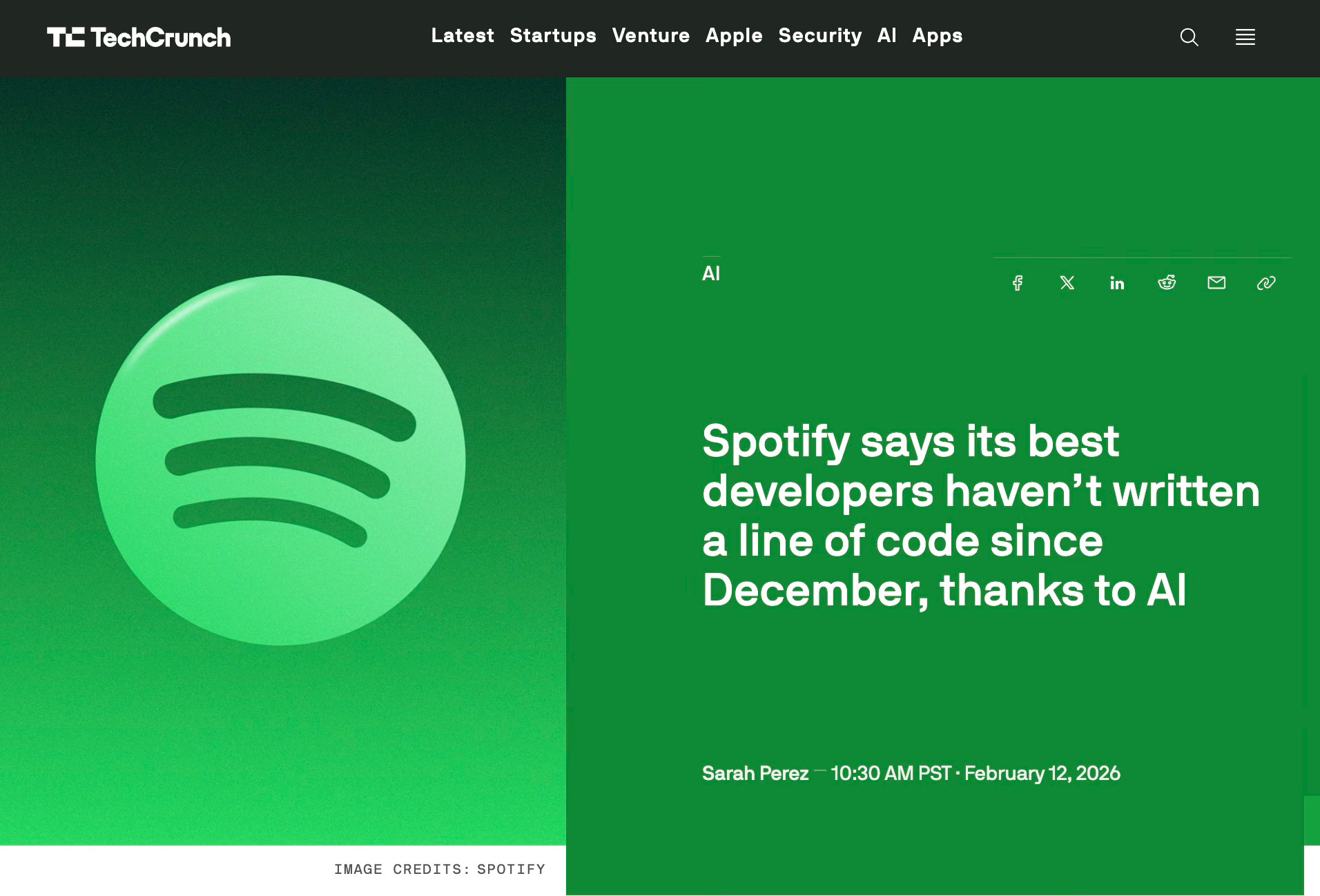
Before, AI would get you 80% of the way there, but you still had to manually fix the last 20% of bugs. Suddenly, people were saying that AI was doing all of their coding.
I knew I should try building software.
I was even excited by the idea.
At the same time, it also filled me with dread because I had already failed before, over and over.
My mom was a computer programmer. She encouraged me to follow that path. So in my teens, I bought the website design books and learned HTML and Adobe Photoshop.
Emboldened by my progress, I bought more advanced programming books and took a computer science course at school. But that’s when I hit a wall. Every time I pushed past the basics, the same cycle started:
I’d write something
It wouldn’t work
I’d spend the next three hours figuring out why
Fix one bug, start building again, hit another.
Most of my time went to debugging. It wasn’t fun.
There was no dramatic moment where I quit. I just gradually stopped trying and made a quiet decision about myself: I’m not a programmer.
After college, I tried the other route to creating software: hiring coders. I found an overseas development team and spent $40,000 over a year, working nights and weekends, building an app that let people track their goals.
I quickly learned what it feels like to depend entirely on someone else to build what’s in your head:
Because of the 12-hour time zone difference, one miscommunication cost a full day.
I couldn’t tell whether a fix should take an hour or a week.
I had no way to tell whether the work was high quality.
It was like bringing your car to a mechanic when you don’t know how a car works. You hand over the keys, you pay the invoice, you hope you weren’t lied to, and you hope your car works when you get it back.
Ultimately, the app failed.
Eventually, I lost interest because the whole process killed everything that made the idea exciting.
By the time AI coding tools arrived, I’d seen the data: virtually every successful software company has a technical founder.
At the same time, I said to myself, “I’m not a programmer. I’m a writer.” I’d made peace with it.
So, when Claude Code launched in 2025, my first reaction was: even if AI writes 95% of the code, I don’t want to spend all my time fixing the other 5%. Even with a shorter learning curve, not worth it.
Then came December 2025, when I saw everyone saying that AI could do 100% of coding. Even though I was interested, I didn’t make time for it. I was busy.
What finally broke through was a friend who sat me down in January and said, “I think you can do this. Let me just show you.”
In one call, he walked me through the basics and suggested a few things to try. For the first time in twenty years, I felt like the “programming door” might not be completely closed.
I tried it. And it wasn’t what I expected.
For my first real project, I decided to create a mental model manual.
I had spent four years creating these manuals by hand for my Mental Model Club. Each one took roughly 50 hours of research, writing, and editing. To start, I downloaded all of the old manuals onto my computer. Then, I asked Claude Code to analyze the structure of each manual. Finally, I asked it to produce a new one in the same structure.
Within a few minutes, I had created a manual on the Second Order Effects mental model. On my very first attempt, it was shockingly close to what took me a month to create manually.
That’s when the lightbulb hit me.
Over the next week, I created 300 more manuals with AI. Same depth as when I did it by hand. But way faster. The numbers didn’t lie:
Before AI: 192 weeks to create 48 manuals
After AI: 1 week to create 300 manuals
That’s an astounding 1,200x multiplier. And it had only cost me $50 (on top of my $200/month subscription).
Then I asked Claude Code to build something more complex. And it did. But the things I had to fix were never the code. My time was spent on:
Deciding what to build
Planning it out
Iterating with the AI
Judging what “done” looked like
For the first time, building software required my expertise, not someone else’s.
And because I wasn’t trapped in debugging hell anymore, something unexpected happened: I was having fun. Not in a forced way. Genuine fun.
I described what I wanted in plain English, and Claude built it. I didn’t write a single line of code. I didn’t read a single line of code.
The systems I’d dreamed about for years, but never had a way to build, were suddenly real. And building them turned out to be the most direct path to everything I’d wanted to do with my work.
After I built one tool, I built another. Then five. Then 20. Then dozens more. In just a few months.
Every one of those tools encodes my expertise in ways that no software company would ever productize, because the knowledge is mine. A 27-step news analysis pipeline built on years of mental models I’ve developed. A writing voice system that captures my exact style. An AI-powered research system with over 12,000 notes searchable by meaning, not just keywords.
None of it required me to be a programmer. It just required my domain expertise and my AI prompting expertise.
After months of spending most of my day programming, I noticed two things that surprised me.
First, I realized I was no longer just a thought leader who happened to program part-time. I was actually a programmer. For example, to generate articles like this one, I spent most of my time developing software to streamline the process. Within a few months, I went from not knowing how to code to identifying as a software engineer. It has been the fastest identity shift I’ve ever gone through in my life.
Second, I realized that I actually love programming now…
The Harvard Research That Explains Why I Was Wrong About How I’d Feel About Programming
There’s a Harvard psychologist named Daniel Gilbert who studies something called affective forecasting: our ability to predict how we’ll feel about experiences we haven’t had yet. His finding, across decades of research, is that we’re terrible at it.
We consistently overestimate how much we’ll hate many things we’ve never tried.
Gilbert’s lab has shown this across romantic breakups, tenure denials, election losses, and dozens of other events people are sure they’ll never recover from. They almost always recover faster than they predicted.
This TED Talk clip summarizes the research:
And, according to a follow-up study, the single best predictor of how you’ll actually feel?
Asking people who’ve already done it.
In the study, Gilbert and his collaborators asked undergraduates to predict how much they would enjoy a 5-minute speed date and a peer evaluation.
One group got detailed information about the event itself.
The other group got just one stranger’s reaction to the same experience.
The strangers’ reactions won.
People who relied on a single secondhand report predicted their own feelings more accurately than people who studied the situation in detail and then predicted how they would feel.
And the kicker: when participants were given the choice, they preferred the detailed information. They actively rejected the strategy that worked.
This research is relevant right now because most of the people who move to coding with AI actually enjoy it. Boris Cherny, the creator of Claude Code, says that this is roughly what he sees at Anthropic among people who make the shift. And Anthropic is at the leading edge of this wave.
Furthermore, Lenny Ratchitsky, who interviewed Cherny, found something similar when he did three polls on X that collectively got 1,500+ responses:
Below are the specific poll results:
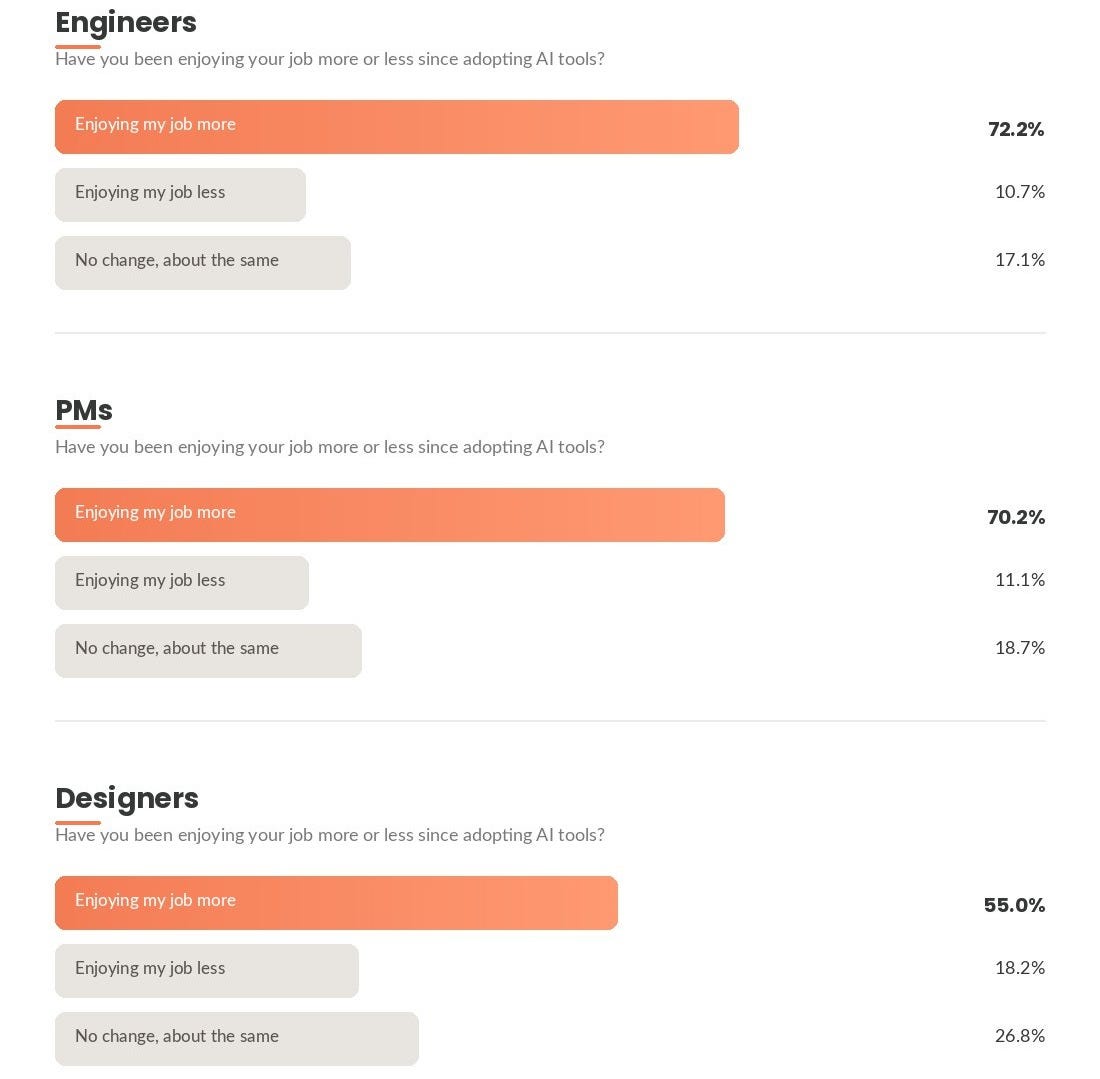
If Gilbert’s research holds and the trend continues, most people who switch to AI programming will enjoy it.
So the emotional barrier is probably lower than you think.
But there's a second barrier most people haven't questioned yet: the assumption that building software requires a different kind of thinking than you’re already using.
It doesn’t.
Your Job Is Already Software. You Just Don’t See It Yet.
Let me show you what I mean.
Strip away the job titles, and every knowledge worker is doing the same three-step loop all day:
Input. Take in information.
Transformation. Make sense of it, process it, create something.
Output. Export the result.
For example:
A lawyer takes in the details of the case, drafts the argument, and files the brief.
A marketer takes in funnel data, develops the angle, and ships the campaign.
An accountant records transactions, prepares the reconciliation, and sends the report.
A designer takes in references, develops the direction, and ships the layout.
Every one of those workflows IS fundamentally like software. Information in. Transformation in the middle. Information out. The shape of every knowledge worker’s job is the shape of a software workflow.
If you’re a consultant or a coach or a strategist and you just felt your jaw tighten at the idea that your job is “fundamentally like software,” I get it. I had the same reaction. My work felt too human, too intuitive, too judgment-dependent to be described that way.
But only the shape of the work is software. The soul of the work is domain expertise.
Looking at the full sweep of knowledge work, four distinct eras emerge, each one inverting the relationship between human and software a little further:
Era 1: Human With Mechanical Tools (before ~1980). Work happens entirely in the human’s head and hands with mechanical tools. Paper, pens, ledgers, typewriters. Software doesn’t exist as a workplace tool.
Era 2: Human With Software (~1980 to present). The human is the agent. Software is the tool. The human does the work, and the software helps along the way. The lawyer types in Word. The accountant works in Excel. The marketer logs into HubSpot. (This is where most of us still are. We've spent our entire careers getting very, very good at being the human in "Human With Software.")
Era 3: Software With Human (2024 to present). The inversion happens. Software does the work. The human directs and judges. The founder doesn’t write the cold outreach. She designs a system that writes thousands of personalized messages while she sleeps. She isn’t using software the way her predecessors used Outlook. The software is doing the work. She’s directing it.
Era 4: Software-Only (~2030+). Software does the work autonomously without human direction in real time. Already true in narrow domains: algorithmic trading, automated support for routine cases, dynamic pricing engines, ad bidding. Likely to expand as Era 3 systems mature.
We are standing at the line between Era 2 and Era 3 right now. The professionals who have already crossed it are building 20x leverage. For example, serial entrepreneur Garry Tan is literally coding 400x faster than before AI:
Source: Y Combinator Podcast
Although Tan is an outlier because he’s an early adopter and world-class software engineer, he’s not alone. Legendary entrepreneur and investor Marc Andreessen reports that programmers in his portfolio company are 20x more productive with AI. This experience also aligns with my daily experience and that of friends who are all in on the tools.
I now believe that, in a year or two, people still operating with an Era 2 mindset (humans with software) will watch their work get done around them by people with a fraction of their experience.
The skill you need to move from Era 2 to Era 3 (software with humans) is Software Authorship: the ability to turn what you know into running software, using English as the interface and AI as the implementation. Not writing code. Just describing what you need, precisely enough that AI can code for you.
Boris Cherny is the head of Claude Code at Anthropic, the tool I use to build my own software. He stopped writing code entirely in November 2025 after AI became good enough to write it for him. But the most important thing he’s said isn’t about coding is about who builds the best software:
“The best person to write accounting software, I think maybe even today, is not an engineer. It’s a really good accountant because they know the domain really well. And coding is the easy part. It’s knowing the domain that’s the hard part.”
The technical part is now the easy part. The knowledge you’ve spent your career developing is the hard part. And “hard” here means “valuable.” It means “irreplaceable.” It means that the person who knows a domain most deeply builds the best tools, because the tools are made of domain knowledge now, not code.
This is why I’m saying that almost every knowledge job has software-shaped holes in it that better software would fill:
The reports your team runs that take hours to compile.
The data hand-offs between systems your IT department keeps promising to fix.
The dashboards you wish you had.
The custom tools that would make your job 40% easier, if only somebody would build them.
The only reason these tools don’t exist is because the supply of programmers has always been tiny relative to the demand for software.
That supply constraint just broke. Because now it’s possible for anyone to build.
The Five-Stage Pattern That Has Reshaped Civilization Twice Is Running Again
Everyone is asking, “Will AI replace me?”
That’s the wrong question for this moment.
The real question is bigger and older: what happens when a skill that only specialists have becomes something everyone can do?
That question has been answered exactly twice in human history. Both times, the answer unfolded as a five-stage pattern that reshaped economies, professions, and daily life. I call that pattern the Literacy Arc.
My mom and my mentor didn't see the Literacy Arc until it was too late. The rest of this article lays out the full pattern so you can see where you are right now and respond better: the five stages, the two forces driving them, the historical precedent, and the specific window that will be open for the next few years.
READ THE REST OF THE ARTICLE
Paid subscribers get:
#1. The full article
The article is roughly 12,500+ words and includes 10+ videos and charts to make the ideas more concrete and visceral.
#2. A multimedia version
This includes slides and an audio podcast you can listen to while walking or doing chores. Scroll to the bottom of this post to access them.
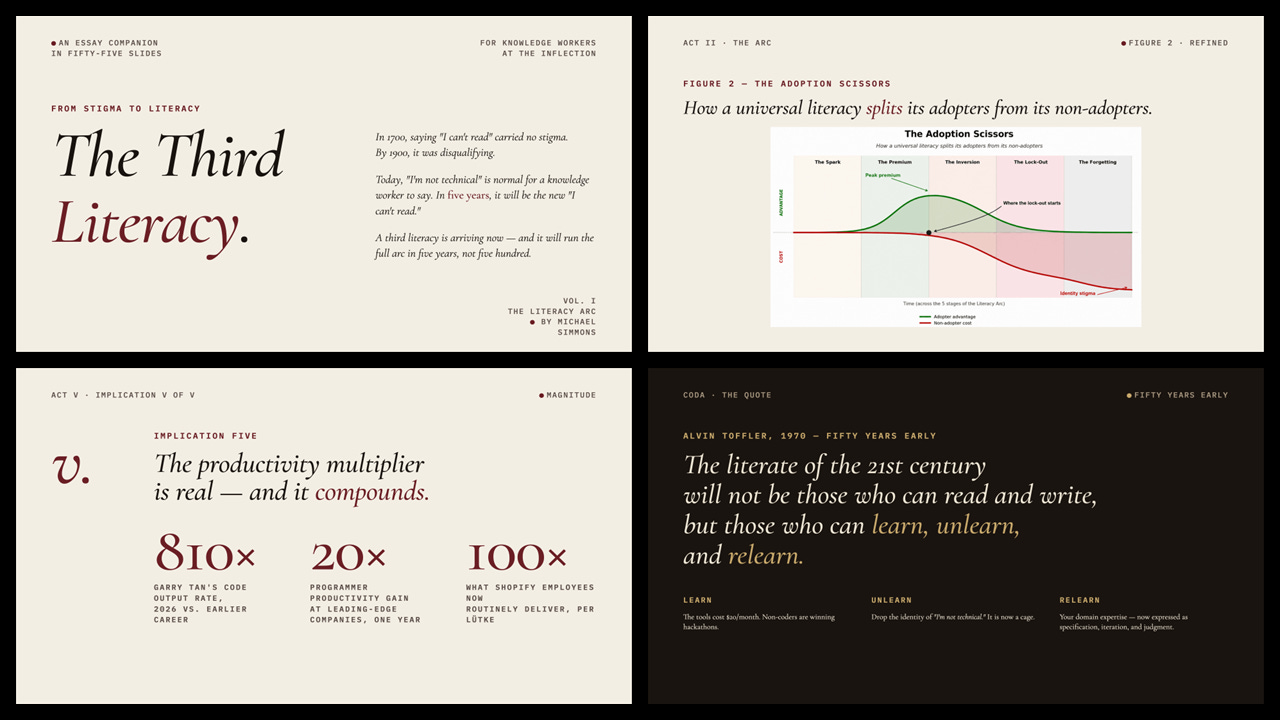
#3. Everything else that comes with the paid membership to this newsletter:
Blockbuster Live. This is a monthly 90-minute masterclass where I share my #1 AI lesson learned for the month.
Augmented Awakening. This is a monthly 90-minute session with world-class coach Anand Rao to help you use AI to augment your personal growth.
Weekly Blockbuster Article (often with a prompt). I share long-form articles about the deepest, most important AI mental models and paradigms that I see no one else writing about. These articles typically come with slides and an audio podcast.
$2,000+ In Other Perks. This includes books, courses, prompts, mental model manuals, and much more…
To summarize, you get two live classes per month, $2,000 in perks, and a weekly blockbuster article for just $20/month or $150/year.
Now let me show you the full pattern…