

Clip Source: Possible Podcast With LinkedIn Founder And AI Investor Reid Hoffman
Quick Summary Of Multi-Prompting
In Multi-Prompting: The #1 NEW Prompting Hack Of AI Power Users, I share a simple prompting paradigm used by the world's top startup founders. Rather than sending important prompts to one model, they:
Send the same prompt to three models (Claude, ChatGPT, Gemini)
Synthesize the AI responses to extract the best insights
This approach is powerful on two levels:
It leverages the Wisdom Of Crowds Effect. It cancels out each model’s weaknesses and multiplies their strengths.
Gives you a dynamic, intuitive understanding of each model. The relative pros and cons of each model compared to the others are constantly changing. Actively using the models is the best way to track what’s different.
In that multi-prompting article, I provided step-by-step instructions on how to multi-prompt and tile your browser windows with one click:
With that context set, let’s dive into the video clip above…
Introducing Agentic Multi-Prompting
In the video above, Parth Patil, who is the “AI right-hand man” for billionaire entrepreneur and LinkedIn founder Reid Hoffman, takes multi-prompting to the next level.
Rather than having three separate chat windows, he has three separate AI agent windows:
Claude Code instead of Claude
Codex instead of ChatGPT
Google CLI instead of Google Gemini
While each of these tools was built for developers, they’re just as valuable for knowledge workers.
On the surface level, this video looks like an AI power user using three different AI agent tools. But it’s actually much more profound than that.
We're witnessing the birth of a new cognitive paradigm—from "AI as tool" to "AI as workforce." The gap between these two approaches is categorical. Most people are using AI as a search engine. Power users are increasingly using AI as a workforce. Thus, I now believe that multi-prompting will be a new mainstream paradigm of knowledge work, not just a helpful hack followed by some power users.
3 Key Quotes From The Clip
#1. Agentic Multi-Prompting
“Anything I care about has 1-3 agents... The first thing I do is I create a folder and I put Claude [Code], OpenAI’s Codex, and Google’s Gemini into that project. And I just send them in three different directions…”
Why This Matters: Most readers are still monogamous with their AI tools—they're "Claude people" or "ChatGPT people." Power users are polyamorous.
#2. He Runs 54 Agents At Once
“I’ve gotten up to like 17 projects where they have on average 2-3 agents in each one.”
Why This Matters: It shows that with today’s tools and our current cognitive capacity, a single individual can coordinate a swarm of AI agents. This begs a profound question about the world we’re entering: “If execution is no longer the bottleneck, what IS your bottleneck?”
For decades, ambitious people have been constrained by execution capacity. You had ideas, but couldn’t pursue them all because building things took time, money, and people. Now, power users can run 17 projects with agents “attacking” them in the background. This fundamentally changes what ambition MEANS.
Not only that, for three years, everyone has said "learn prompt engineering." But power users have already taken it a step further. They're not just writing better prompts; they're designing cognitive architectures for orchestrating dozens of simultaneous AI initiatives. The skill that will matter more and more is orchestration, and almost nobody is teaching it. For more on this, I recommend reading my article 10,000x Knowledge Worker: How History’s Forgotten Productivity Secret Reveals AI’s True Potential.
#3. He Lets The Agents Run For Entire Days
“If you give them [frontier models] a good approach to planning and you say, ‘Make sure you write down the plan and periodically update your status in the plan,’ you can say, ‘Go work on this for today,’ and it will continue to work in a loop for a whole day, even longer than that.”
Why This Matters: We’re at a critical juncture where models can suddenly work for long periods of time productively. The following chart from research organization METR says it all:
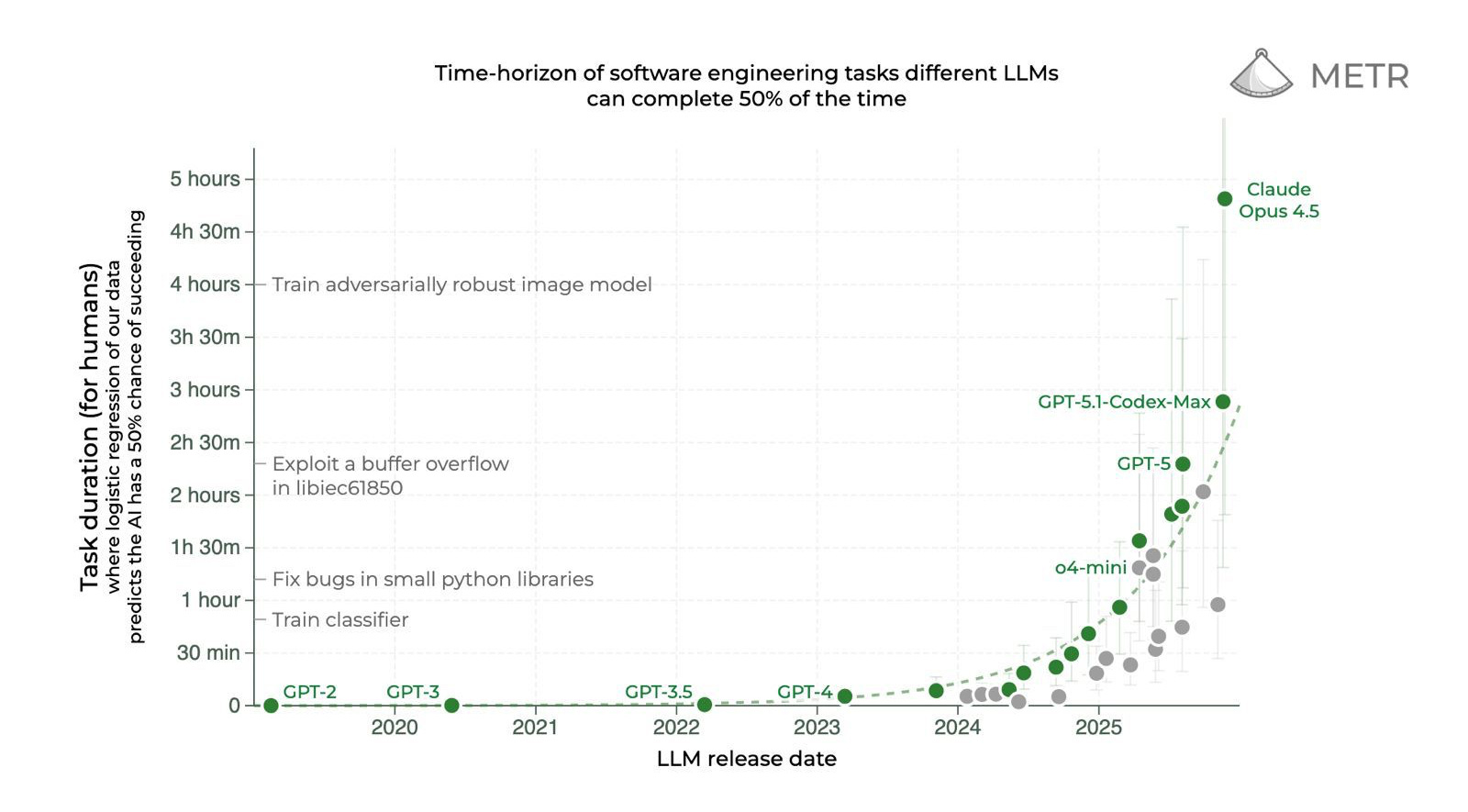
Summarizing 6 years of data, METR says:
“We propose measuring AI performance in terms of the length of tasks AI agents can complete. We show that this metric has been consistently exponentially increasing over the past 6 years, with a doubling time of around 7 months. Extrapolating this trend predicts that, in under a decade, we will see AI agents that can independently complete a large fraction of software tasks that currently take humans days or weeks.”
Extrapolate the curve. By the end of 2026, the length of software tasks that AI models complete 50% of the time will be 4x what it is now.


