

Clip Source: Possible Podcast hosted by Reid Hoffman, founder of LinkedIn, with guest Parth Patil
WHAT YOU GET IN TODAY’S POST
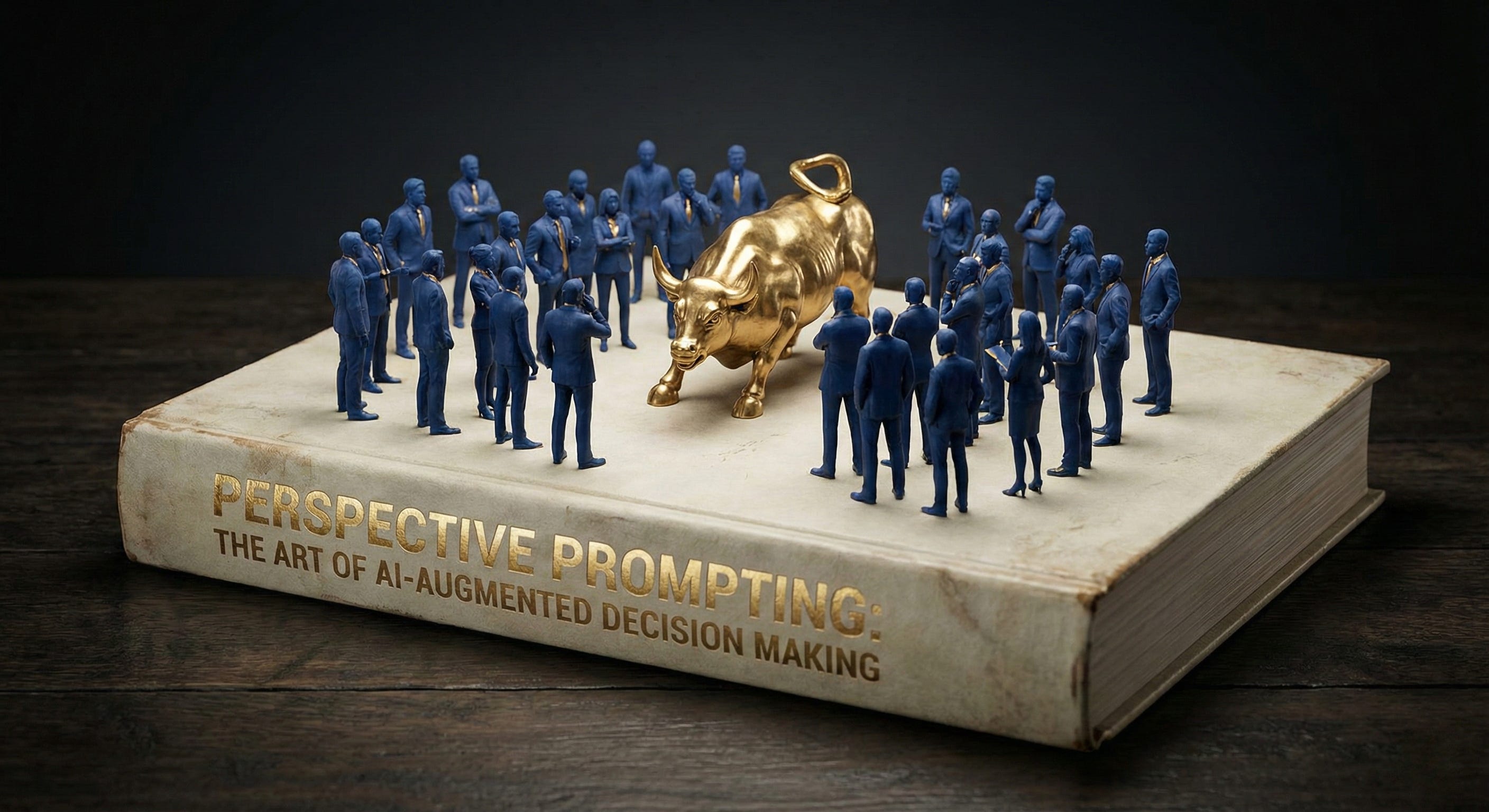
Free Subscribers Get:
I worked on this article for dozens of hours with the support of Bonnie J. and the Blockbuster mental model.
Why did we spend so much time?
Without a doubt, I have used the Wisdom Of Crowds mental model more than any other. Yet, few people actually understand it. And almost no one uses it in their prompts.
To my knowledge, this is the most comprehensive article ever written on how to use AI to generate a “Wisdom Of Crowds Effect” so that you can make drastically better decisions, learn faster, and be more creative.
In the article, you’ll discover:
Why diverse perspectives mathematically compound accuracy
A framework for selecting perspectives whose blindspots cancel each other out
What happens when you stop asking AI for answers and start using it to transform the questions themselves
7 proven quick-win AI prompts you can copy & paste and put to use right away
Paid Subscribers Get:
To multiply the value of the article, I’ve also created five bonus resources for you:
Bonus #1—Comprehensive Council Prompt: Install this prompt in your system settings so you can easily use a council of world experts whenever you want.
Bonus #2—Wisdom Of Crowds Curriculum: Identify 30+ micro-skills you can learn to more effectively use the Wisdom of Crowds in your life. Receive a prompt that will help you learn any of the micro-skills quickly.
Bonus #3—Further Reading (Downloads + ChatBot): This bonus includes the top three books I recommend reading, links to 34 studies you can download and talk to with NotebookLM, and 33 books I recommend referencing when you talk to AI.
Bonus #4—Wisdom Of Crowds 35-Minute Podcast Episode: Listen to a NotebookLM-generated synthesis of dozens of books and studies on the Wisdom Of Crowds so you can digest the big ideas in a conversational format while walking or doing your chores.
Bonus #5—15 Drafts Rule Template: I provide you with my Wisdom Of Crowds inspired template that I share in my $10,000 year-long training and that I use religiously. You can use it for yourself to become a better writer, with people who edit your work, or with AI.
Paid subscribers get all of these perks in addition to $2,000+ in other membership perks (3 books, 7 courses, dozens of prompts).
FULL ARTICLE
You are a prisoner of your own perspective.
When you try to “think outside the box,” you are still using the box to do the thinking. You imagine what a skeptic would say, but that skeptic is just a character you created. You consider the investor’s view, but that investor shares your blindspots because they live in your head.
This is a limit of human cognition.
No matter how hard you try to roleplay other perspectives, you are ultimately running them through a single processor: you. Your biases, assumptions, and experiences act as an invisible filter that distorts every viewpoint you try to adopt.
But in 1906, statistician Francis Galton accidentally discovered how to bypass this biological limit.
At a county fair, 787 random people guessed the weight of an ox. Galton set out to prove the crowd’s folly, but he discovered their collective genius. The crowd’s median missed by just 9 pounds. Less than 1% error. Much closer than the guesses of individual experts—butchers and farmers—who Galton had also invited to participate.
The random crowd had beaten the cattle experts.
Galton published his findings in Nature:
“The result seems more creditable to the trustworthiness of democratic judgment than might have been expected.”
A century later, scientists from dozens of disciplines have tested this “Wisdom Of Crowds” phenomenon. The resounding finding is this…
For problems of judgment and estimation, the messy, complex decisions that actually matter in business and life, when you collect multiple, diverse, independent perspectives and synthesize them in the right way, the errors literally subtract out. The crowd becomes superintelligent, often smarter than the smartest people in them.
The Wisdom Of Crowds Approach Has Proven Itself Over And Over
The principle Galton stumbled upon wasn’t an anomaly. Experts across dozens of fields have independently rediscovered this pattern over the last century. Here are fascinating examples (out of hundreds that exist in the literature):
#1. Predicting the future
It’s the principle superforecasters used to beat CIA analysts with classified briefings by 30%. The principal AI researchers discovered that ensembles of AI models outperform any single model.
#2. Honeybee collective wisdom
It's the principle that honeybees discovered millions of years before Galton. When a swarm needs a new home, scout bees independently evaluate potential sites, return to perform “waggle dances” proportional to site quality, and through this distributed deliberation, the swarm chooses the best cavity 80% of the time.
#3. Mass human collaboration
It’s the principle that makes Wikipedia more accurate than experts predicted. When Nature compared 42 science articles to Encyclopedia Britannica, Wikipedia’s error rate was only slightly higher, despite being written by anonymous amateurs, because millions of small edits from diverse contributors gradually canceled out individual errors.
#4. Business Decision-Making
It’s the principle that self-made billionaire investor Ray Dalio encoded into the operating system of the world’s largest hedge fund. For any significant decision, he triangulates with at least three "believable" people with track records in the relevant domain, weights their views by credibility, then has them debate each other. This systematic aggregation, Dalio argues, is the core mechanism behind his success.
Bottom line:
What if you could make the best choice 80% of the time, like honeybees do? Or if you could predict the future 30% more accurately than the experts, like superforecasters in the CIA study?
It’s possible.
But in order to tap the Wisdom of Crowds, you have to assemble groups of people, build systems, or wait for natural processes to unfold.
It’s not easy.
At least, it wasn’t before AI…
How To Easily Apply The Wisdom Of Crowds On Demand With AI
AI can adopt any perspective instantly (e.g., investor, scientist, skeptic, historian, competitor) without the ego, confirmation bias, or psychological baggage that make us prisoners of our own viewpoints.
Which means you can now do something previously impossible:
Summon a council of expert perspectives in minutes
Design productive disagreement between them
Watch their blindspots cancel each other out
Synthesize insights no single viewpoint could reach
I call this approach Perspective Prompting.
Based on the research and what I’m seeing from the world-class AI practitioners, I believe it’s about to become the standard for serious AI-augmented decision-making.
If you’ve ever had the nagging sense that you’re missing something obvious, something someone with a different background would immediately see, you were right.
But now there’s a way to see it...
Introducing Perspective Prompting
In the following five sections, I decode the key principles of Perspective Prompting:
Go beyond your own perspective
AI is better at perspectiving than humans
Multiple perspectives are better than one
You can collect different types of perspectives
You can synthesize multiple perspectives to get world-class insights
#1. Go Beyond Your Own Perspective
“We need to get out of our own perspective.”
—Parth Patil
"We don't see things as they are, we see them as we are."
—Anaïs Nin
You probably think you’re good at considering other perspectives. Most intelligent people do.
But here’s the problem: you can’t think your way out of your own perspective.
Think about what happens when you try. You want to see things differently, so you imagine another viewpoint. But your mind is already shaped by your existing beliefs, biases, and assumptions. The instrument you’re using to “escape” your perspective is the very thing that’s limited by it. It’s like trying to see your own blind spot by looking harder, with the eye that has the blind spot.
Or imagine you’ve worn tinted glasses so long you forgot they’re there. Everything looks slightly blue, but you don’t notice because you’ve never seen it any other way. Now, someone asks you to imagine what the world looks like without the tint. You try, but you’re still looking through the blue glasses. Your attempt to see “without bias” is still biased.
No matter how hard you try to “think from someone else’s perspective,” it’s still you doing the thinking. Your invisible filters and assumptions come along for the ride.
We all believe we see the world objectively, while people who disagree are “biased” or “uninformed.”

The uncomfortable finding: intelligence doesn't protect you from bias. It often makes you better at defending beliefs you already hold. The smarter you are, the more sophisticated your rationalizations become.
#2. AI Is Better At Perspectiving Than Humans
“You'll find that the model can emulate all these perspectives... So, even if you don’t have that person sitting next to you, you can simulate that perspective. And then the AI playing that role will help you understand your problem even in a way that you didn’t even consider.”
—Parth Patil
"A great many people think they are thinking when they are merely rearranging their prejudices."
—William James
As I share in, This One Article Written By AI Will Change How You Interact With AI Forever (At Least It Did With Me), AI can instantly adopt different perspectives on a much deeper level than humans can.
When you ask AI to think like a skeptic, it doesn’t have to overcome a lifetime of optimistic tendencies. And it can instantly switch between perspectives without any cognitive dissonance.
This is where AI is structurally different from you and me.
AI has no ego to protect, no "home perspective" to escape. When you ask it to argue against your position, there's no identity threat, no subtle weakening of the counterargument. It inhabits the perspective of a skeptic, competitor, or expert without the psychological resistance that makes humans soften uncomfortable viewpoints.
Humans, in many ways, are their perspective.
They argue fiercely for their own and attack those who disagree:
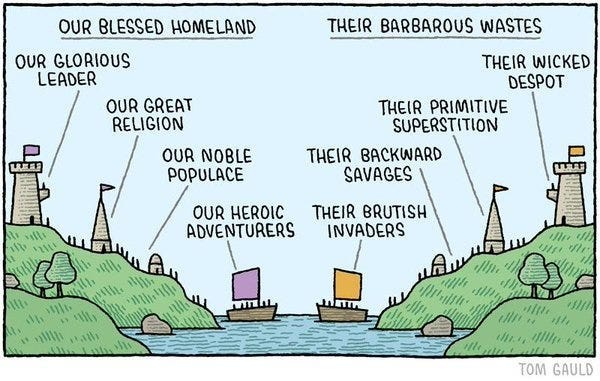
Thus, we confirm what we already believe:
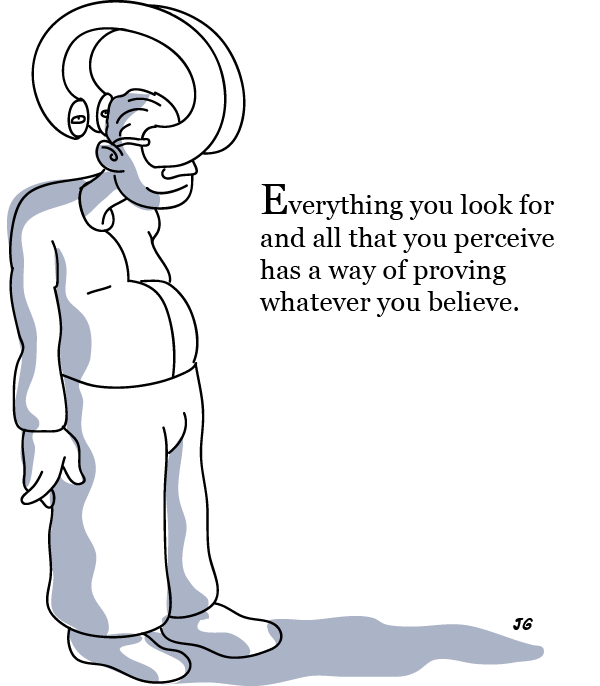
AI wears perspectives like costumes—inhabiting each role without the friction of self-protection.
AI perspectives aren’t perfect. They’re approximations. But for escaping your own cognitive traps, even imperfect outside perspectives are dramatically better than having none.
#3. Multiple Perspectives Are Better Than One
“I once had a coding agent generate 100,000 unique expert personalities. It turns out if you create 100,000 unique experts, you kind of cover every single topic or a huge swath of all the topics that humans have—covering everything from parenting to Legos to every single form of art that the models have been trained on. And you get this very multifaceted set of like minds that you can tap into.”
—Parth Patil
For every problem, there is a set of perspectives that can help us solve it better.
This is because complex problems aren’t one-dimensional. They have financial, emotional, technical, ethical, and temporal dimensions. A single perspective, no matter how sophisticated, optimizes along one or two dimensions while treating the others as background noise.
When you summon multiple perspectives, you’re not just getting multiple answers. You’re illuminating multiple dimensions of the problem that would otherwise remain invisible. The accountant reveals the financial dimension. The psychologist reveals the emotional. The historian reveals the temporal. Together, they don’t just give you more opinions, they give you a more complete map of the problem itself.
What makes AI perspectiving unprecedented: the sheer number of perspectives you can access. Assembling five genuine experts in one room requires coordination, scheduling, budget, and luck. Ten experts is a major undertaking. Twenty is a conference.
But AI has no such constraints. You can summon a hundred perspectives in minutes. A thousand, if you want. At that scale, you’re approaching comprehensive coverage of how humans have learned to think about problems.
Every mental model, every disciplinary lens, every cultural framework that’s been encoded in text becomes accessible on demand.
#4. You Can Collect Different Types Of Perspectives
When most people think "get different perspectives," they default to experts in different fields. A lawyer, an accountant, a marketer. But expertise is only one dimension of perspective diversity, and sometimes not the most important one.
In the video, Parth shows a few different types of perspectives that he finds particularly fruitful:
Expertise Perspectives (eg, venture capitalist, product manager, CEO)
Field Perspectives (eg, artistic, scientific)
Mental Model Perspectives (eg, 80/20 Rule, Blue Ocean Strategy)
Thinking Perspectives (eg, devil’s advocate, systems thinker)
Mindset Perspectives (eg, optimist, pessimist)
Customer Perspectives (eg, prospects, true fans, segments)
These point to a larger, richer landscape of valuable perspective types:
Stakeholder Perspectives (boss, subordinate, partner, board member): Before any significant meeting, you can simulate the perspectives of every person in the room. What does the CFO's cost-minimization lens see that your opportunity lens misses? What's the legal team worried about that engineering hasn't considered? Where will the CEO's priorities create tension with your proposal?
Temporal Perspectives (historian, futurist): Every decision exists in time, yet most analysis ignores this dimension. Ask: "How would a historian who studied similar industry transitions view what's happening?" The historian reveals patterns you're inside of but can't see. The futurist identifies what you'll wish you had questioned while you still had time.
Failure Mode Perspectives (the post-mortem analyst, the disappointed customer, the "I told you so" colleague): Before major decisions, pre-experience failure from multiple angles. Ask: "Imagine this project failed spectacularly. As the analyst writing the post-mortem, what obvious warning signs were ignored?" Or: "As a customer who was initially excited but ultimately churned, what disappointed you most?" These perspectives surface risks that optimistic planning misses. The uncomfortable viewpoint you'd rather avoid is often the one you most need.
Outsider Perspectives (the intelligent newcomer, the child, the person from a different industry): Domain expertise is a double-edged sword, revealing deep patterns, but also blinding you to your field's unquestioned assumptions. Ask: "How would an intelligent person encountering this problem for the first time describe it?" Or: "What would someone from a completely different industry find strange about how we do things?" The newcomer asks the obvious question everyone stopped asking years ago. The outsider notices the assumption so embedded that it’s invisible to you.
Methodological Perspectives (Qualitiative, Quantitative): The quantitative lens provides the structural backbone, using objective data, statistical trends, and measurable metrics to establish scale and certainty. Complementing this, the qualitative lens adds the necessary human dimension, exploring the nuances of lived experience, cultural context, and subjective motivation. Together, they form a holistic view where the precision of numbers meets the depth of narrative, ensuring that insights are both statistically significant and contextually meaningful.
Cross-Cultural and Cross-Disciplinary Perspectives (the Japanese quality engineer, the Danish work designer, the physicist looking at your marketing problem): Different cultures and disciplines have developed fundamentally different ways of seeing. Ask: "How would the Japanese approach to kaizen inform our improvement process?" Or: "What would a physicist notice about the dynamics of this system that business thinking misses?" These perspectives don't just add viewpoints. They add entire frameworks of thought. The discipline that seems least relevant to your problem may hold the mental model you're missing.
Here’s what matters about having multiple perspective types, not just multiple perspectives: each type has blindspots the others don’t share.
Expertise perspectives miss what beginners notice.
Optimist perspectives miss what skeptics see.
Team perspectives miss what adversaries would exploit.
Temporal perspectives reveal what present-focused analysis ignores.
Qualitative perspectives miss what quantitative perspectives reveal.
When you assemble perspectives from across types, you systematically cover the territory of possible blindspots.
#5. You Can Synthesize Multiple Perspectives To Get World-Class Insights

When you aggregate diverse perspectives, errors cancel and accurate judgments compound. But there’s a crucial distinction most people miss.
Synthesis is not the same as averaging.
If you ask five people for their opinion and then split the difference, you don’t get wisdom, you get mush. The magic of Galton’s ox-weighing experiment wasn’t that someone calculated a mean. It was that independent errors pointed in different directions and neutralized each other.
Psychologists David and Roger Johnson spent fifty years studying what they call “constructive controversy.” Their finding: groups that explicitly surface disagreements and argue through them produce significantly better decisions than groups that seek consensus or simply average inputs. This finding matches the findings from the academic literature review that James Surowiecki did in the initial Wisdom Of Crowds book:
“The best collective decisions are the product of disagreement and contest, not consensus or compromise.”
― James Surowiecki, The Wisdom of Crowds
The synthesis step is about mining the tensions for insight.
This is why Perspective Prompting isn’t just “ask AI for multiple opinions.” It’s about designing productive conflict between perspectives.
For the Wisdom of Crowds to work, four conditions must hold:
Condition #1: Independent Perspectives (extract rare and valuable insights)
"Paradoxically, the best way for a group to be smart is for each person in it to think and act as independently as possible."
—James Surowiecki, author, Wisdom Of Crowds
“Wise people apply multiple models like a doctor’s set of diagnostic tests.”
—Scott Page, researcher
Condition #2: Diverse Perspectives (cancel out biases)
"When the diversity in a group is large, the error of the crowd is small."
—Scott Page, researcher
“Progress depends as much on our collective differences as it does on our individual IQ scores.”
—Scott Page, researcher
Condition #3: Synthesis (generate emergent insight)
"Consensus is not always good; disagreement not always bad."
—Phil Tetlock, researcher and author, Superforecasting
“Wise people and teams construct a dialogue across models, exploring their overlaps and differences.”
—Scott Page, researcher
Condition #4: Aggregation mechanism (like a market, a vote, or an algorithm)
"With most things, the average is mediocrity. With decision making, it's often excellence."
—James Surowiecki, author, Wisdom Of Crowds
AI meets all four conditions in ways human groups rarely can. Each perspective that you prompt can be independent (if structured in the right way). You can summon diversity on demand—economist, psychologist, competitor, skeptic—without needing to know people in those fields. And AI synthesizes at speed, identifying tensions and generating integrations that would trigger emotional arguments in a human team.
The result is collective intelligence that exceeds what any single perspective could produce.
Let’s make Perspective Prompting more concrete...
What Perspective Prompting Looks Like In Practice
You’re weighing a major career decision, leaving stability for an opportunity that excites and terrifies you.
The normal approach: You ask AI, “Should I take this risk?” You get a thoughtful pros-and-cons list. Balanced. Reasonable. And not particularly useful, because it’s the same analysis you’ve already been running in your own head.
The perspective prompting approach: You ask AI to respond from five distinct viewpoints:
A mentor who’s watched dozens of people make similar leaps
Someone who made a similar leap and failed
Someone who made a similar leap and succeeded
Your future self, five years from now
A psychologist analyzing your decision-making patterns
Now something different happens:
The failed founder warns you about the runway mistake everyone makes. You’re underestimating how long things take by at least 2x.
The successful founder says the runway concern is overblown; what actually matters is whether you can tolerate prolonged ambiguity.
Your future self doesn’t care about the money. They want to know which regret you could live with.
The psychologist notices a pattern: you keep framing this as “risk vs. safety” when the real tension might be “external validation vs. internal alignment.”
The perspectives don’t just give you more information. They reframe the question itself.
You came in asking, “Should I take this risk?”
You left asking, “Am I running toward something or away from something?”
Not only that, simply reading each perspective, rather than just the synthesis, transforms you at a deeper level.
Personal Case Study: How I Used The Wisdom Of Crowds To Go From Zero To 200,000+ Views Per Article
In 2013, I started writing for Forbes with no audience and a desire to create ideas that could change the world.
Having had an unsuccessful blog in the past, I knew I needed to do something different if I wanted to make that vision a reality.
That’s when I came upon the Blockbuster approach. Rather than focusing on making each article “good enough”, I focused on making each work the best I possibly could. And to my amazement, it worked right away. Every time I improved the quality of my writing, my reach and impact skyrocketed. Within two years, I had 50,000 readers per article.
So, I thought to myself:
If increasing quality has worked so well, what would happen if I took it to a higher level?
This question is what led me to the Wisdom Of Crowds approach and eventually to a thought leadership mental model I created called The 15 Drafts Rule. This mental model was key to my average views per article increasing to 250,000+ soon after.
When most people edit an article, they do a general edit to see what they can improve. With the 15 Drafts Rule, I did 15 rounds of editing, each from a different perspective.
My approach was two-fold:
Leverage the “Crowd Within” to tap into my own diverse perspectives.
Get feedback from 5+ people for every article so I could further uncover my blindspots.
Below are 5 of the 15 drafts I religiously use:
Intuitive Perspective. The vomit draft gets all of the ideas out of your head onto paper. The goal is to do a brain dump with zero editing in order to tap into your intuition.
Hook Perspective. The first heavy lifting any content needs to do is to grab someone’s attention in the newsfeed. Once they visit your article, you then need to get them to keep reading. On average, only 1% of people click to read articles in their newsfeed. From there, nearly 50% of readers abandon articles in the first 10 seconds. That means that within 10 seconds, most articles have already lost 199 out of 200 potential readers. Yet, most writers “bury the lede.” In other words, they put the hook later in the article after many readers have already abandoned it. This is why it’s so important to find, build, and highlight your hook right away. This forms the foundation for your title, intro, and headers.
Layman’s Perspective. When you spend a lot of time on any topic, you suffer from the curse of knowledge. It’s hard for you to put yourself in the reader’s shoes when they’re being exposed to the topic for the first time. The goal of this perspective is to provide this beginner outsider perspective and make it so an 8-grader could understand it.
Trademark Ideas Perspective. One of the highest leverage opportunities for any thought leader is to coin a phrase that becomes so important that everyone in a niche, industry, or profession uses it. This perspective helps you look for naming opportunities within your article.
Comprehensive Perspective. Get all of your main ideas into the draft without regard for trimming anything. The benefit of this step is that it helps you see the big picture and get deeper clarity on what your big idea really is. This step often requires doing a literature review of everything that has been written about the topic directly and adjacently.
Paid subscribers can get a link to the other 10 drafts at the bottom of this article. You can use this template for yourself, with other human editors, or with AI.
The 15 Drafts Rule template is just one example of many ways to derive benefits from the Wisdom Of Crowds approach, For example…
I’ve studied mental models across dozens of disciplines in order to collect diverse insights from various disciplines.
I’ve purposely built relationships with people who have developed expertise in many disciplines.
I used 30+ perspectives to craft The Largest Religion In 10 Years Won’t Be Christianity, Islam, Buddhism, Atheism.
In every single prompt, I have AI point out the perspectives I used and could’ve used but didn’t.
And much more.
The Most Surprising Benefits Of Perspective Prompting
Perspective prompting doesn’t just help you make better decisions; it also helps you:
Extract value from domains you didn’t know existed
Productively communicate with people who hold irreconcilably different perspectives
Create “Anti-Fragile Ideas”
Do “infinite audience testing” for free
Boost your creativity
Grow developmentally
#1. Extract value from domains you didn’t even know existed
Knowledge work increasingly requires expertise from domains you don’t personally possess. The product manager needs to understand enough engineering to make good trade-offs. The marketing leader needs to understand enough data science to evaluate attribution models. The project manager needs to understand enough of everyone’s domain to coordinate effectively.
In the past, you had to know a domain existed so you could enter its keywords into Google. But now, with AI perspectiving you can rapidly access domain perspectives you’d need years to develop through traditional learning.
QUICK WIN PROMPT FOR EDITING ARTICLE

List all of the perspectives I take in this article grouped into categories.

What are new categories of viewpoints and viewpoints within those categories that are in my blindspot that would drastically increase the quality of the ideas in the article and help me evolve a stage developmentally or in how I perspective on a meta level?
QUICK WIN PROMPT FOR SEEING MISSING PERSPECTIVES IN ALL OF YOUR PROMPTS
Go to the general settings page (Claude / ChatGPT) and add the following text:
"When responding to my initial prompts, identify which cognitive operations / frames / mental models / paradigms I'm employing and which ones I'm not yet aware that I could be using."#2. Productively communicate with those who have irreconcilably different perspectives
One of the most persistent problems in knowledge work is stakeholders talking past each other. Engineering and sales have different vocabularies, success metrics, and temporal horizons. What sounds like agreement often masks fundamental misalignment that only becomes visible during execution. Or what sounds like profound disagreement may mask underlying alignment.
QUICK WIN PROMPT

AI perspectiving enables a new form of stakeholder translation. Before communicating across domains, ask:

“How would an experienced [their role] interpret what I’m about to say? What would they hear that I don’t intend? What concerns would this raise that aren’t on my radar?”
#3. Create “Anti-Fragile Ideas”
Ideas that survive rigorous multi-perspective criticism are stronger than ideas that merely avoid criticism. But most thought leaders never subject their ideas to serious challenge before publication. They develop arguments in echo chambers of supportive feedback, encountering criticism only when it’s too late to improve the idea.
QUICK WIN PROMPT

AI perspectiving allows you to systematically expose ideas to hostile criticism during development. That way when you publish, they are rock solid. Ask AI to:

"Generate the 10 most sophisticated critiques from different disciplinary perspectives—the philosopher, the empiricist, the historian, etc."
#4. Do “infinite audience testing” for free
Before AI perspectiving, understanding your audience was guesswork. You made creative choices based on intuition and got feedback from a small sample of trusted colleagues. Or, you performed expensive tests with live audiences.
You can now simulate how different audience segments might respond to your work before you finish it. Want to know how a skeptical literary critic might receive your manuscript? A genre-savvy superfan? A distracted casual reader scrolling their phone on the subway? You can instantiate all these perspectives simultaneously with AI.
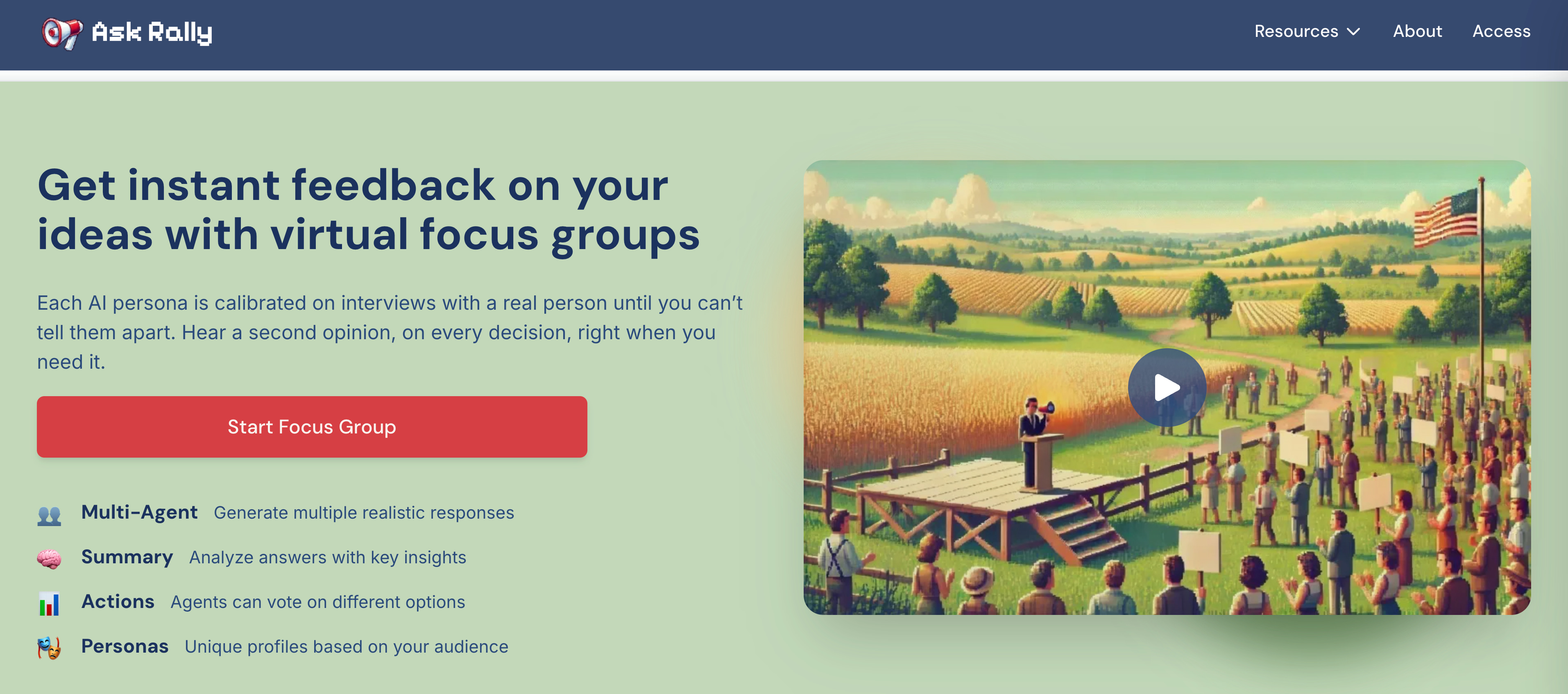
There’s even a tool, Ask Rally, that helps you get feedback from your customer segments with Perspective Prompting:
If you’re wondering: how effective would AI be at simulating my audience?
The answer is: very!
In one study, researchers used Viewpoints AI to generate 19,447 AI personas and simulate responses to media stimuli from 45 published experiments (133 findings) in the Journal of Marketing. The AI persona simulations reproduced 76% of the original main effects. The implication: LLMs may already function as a compressed simulator of average human sense-making, even if they fail at individual-level prediction.
In another study, ~1,000 LLM agents produced insights comparable to traditional A/B tests.
QUICK WIN PROMPT

Attached is a rough draft of an article I'm working on.

My core audience segments are:

1. [AUDIENCE SEGMENT NAME #1]:
2. [AUDIENCE SEGMENT NAME #2]:
3. [AUDIENCE SEGMENT NAME #3]:

For each audience segment share:

- How they would rate the article on a 1-10 scale (10=blockbuster)?
- What's the #1 thing they'd recommend doing to make it a 10?
- Detailed, comprehensive general response to the article
- Problem areas in the article where they would be most likely to bounce
- Ideas in the article they would most love
#5. Boost your creativity
The most distinctive creative work often emerges from unexpected combinations. Jazz emerged from the collision of African rhythmic traditions and European harmonic structures. Magical realism emerged from the collision of mythological thinking with documentary impulses. Hip-hop emerged from the collision of DJ culture, spoken word, and sampling technology.
AI perspectiving offers a systematic way to generate creative collisions. Look for the synthesis that neither perspective alone would produce.
QUICK WIN PROMPT

I am writing about [Current Trend: e.g., The Future of AI in Marketing].

Synthesize this with the following two perspectives:

1. The Stoic Philosopher (2,000 years ago): What would Marcus Aurelius say is the 'unchanging human nature' at the core of this trend?

2. The Sci-Fi Visionary (100 years in the future): Looking back, what would they say was the most 'quaint' or 'obvious' mistake we are making right now?

Then, uncover a 'Timeless Principle' that makes my current advice look deeper and more grounded than the typical 'news-cycle' commentary.
#6. Grow developmentally
In addition to making better decisions, there's a deeper benefit that's easy to miss: perspective prompting can actually change how you think.
Psychologist Robert Kegan spent decades studying how adults develop in the complexity of their thinking. He found that growth happens through "optimal conflict": encountering a perspective or problem that reveals the limits of your current way of seeing. The challenge must real enough that you can't dismiss it, in a domain you care about, and you must be supported enough that you don't shut down or flee.
This is surprisingly hard to achieve in normal life. Colleagues soften their feedback. Friends share your assumptions. Consultants tell you what you want to hear. And when genuinely challenging perspectives do arrive, they often generate defensiveness, damaged relationships, bruised egos.
When you summon a perspective that fundamentally challenges your worldview with AI, there's no relationship to protect, no face to save. You can ask the adversarial perspective to go harder. You can explore the discomfort without performing composure. You finally have access to calibrated cognitive challenge: difficult enough to stretch your thinking, safe enough to stay with it. If you seek this out, you’ll become a more complex thinker.
QUICK WIN PROMPT

"I am currently struggling with [Situation/Decision: e.g., whether to fire a well-liked but underperforming employee].

I want you to help me grow developmentally. Please take on two roles:

1. The Developmental Psychologist: Analyze my description and identify the 'Internal Logic' or hidden 'Subject-Object' trap I’m stuck in (e.g., am I prioritizing harmony over mission? Am I defined by others' opinions?).

2. The Challenger: Present the most sophisticated, high-integrity version of the perspective I am currently 'avoiding' or 'devaluing.' Don't make it a strawman; make it so compelling that I have to wrestle with it.

End by asking me one 'Killer Question' that forces me to step into a more complex version of myself to answer it."
The Science Behind Perspective Prompting
Understanding why the Wisdom of Crowds works and when it fails transforms Perspective Prompting from intuition into a systematic practice. Key insights from the research:
#1. The Diversity Prediction Theorem: The Mathematics of Collective Intelligence
Scott Page, a complexity scientist at the University of Michigan, formalized Galton’s observation into a precise mathematical relationship. His Diversity Prediction Theorem states:
Collective Error = Average Individual Error − Prediction Diversity
This equation reveals something counterintuitive: a group’s accuracy depends not just on how smart its members are, but on how differently they think. When perspectives are diverse, their errors don’t correlate. So when aggregated, the errors cancel while accurate judgments are reinforced.
In his landmark 2004 paper with Lu Hong, Page demonstrated that diverse groups of problem-solvers consistently solved more problems correctly than the “expert” homogeneous groups, despite the individuals in the latter group being more capable on their own. Not because diversity is politically correct, but because of mathematics.
The implication: you're not looking for AI's "best" answer. You're engineering a collection of perspectives whose blindspots don't overlap, so the collective vision exceeds any individual perspective.
For deeper exploration: Scott Page's The Difference: How the Power of Diversity Creates Better Groups, Firms, Schools, and Societies (2007) and The Diversity Bonus (2017).
#2. Superforecasting: What Separates Good Judgment from Bad
Philip Tetlock, a University of Pennsylvania psychologist, conducted the largest forecasting study in history. Over four years, thousands of amateur forecasters predicted geopolitical events. Tetlock tracked their accuracy.
He found that a small group of “superforecasters” consistently outperformed professional intelligence analysts with access to classified information by roughly 30%.
What made them so good?
Tetlock identified a key trait he called “active open-mindedness”—actively seeking out perspectives that challenge your initial conclusions. As Tetlock puts it:
“For superforecasters, beliefs are hypotheses to be tested, not treasures to be guarded.”
Superforecasters didn’t just tolerate opposing views; they hunted for them. They constantly asked:
“What would have to be true for my view to be wrong? Who sees this differently, and why?”
Perspective prompting systematizes this discipline, making it easy to outsource active open-mindedness.
For deeper exploration: Philip Tetlock and Dan Gardner’s Superforecasting: The Art and Science of Prediction (2015).
#3. Constructive Controversy: Why Debate Beats Averaging
David W. Johnson and Roger T. Johnson, psychologists at the University of Minnesota, have studied “constructive controversy” for over five decades. Their research demonstrates that structured intellectual disagreement produces better outcomes than either consensus-seeking or simple averaging.
The key finding: groups that explicitly surface disagreements, argue positions, and synthesize opposing views produce significantly higher-quality decisions than groups that either: (a) seek consensus to preserve harmony, or (b) average inputs.
Johnson and Johnson’s meta-analyses, summarizing hundreds of studies, show that constructive controversy leads to:
Higher-quality decision-making and problem-solving
Increased creativity and perspective-taking
Greater mastery and retention of information
Better relationships among participants
When you’re confronted with a genuinely different perspective, you experience “conceptual conflict”: uncertainty about whether your view is correct. This uncertainty motivates deeper information search and more careful reasoning.
This is why perspective prompting isn’t just about collecting multiple viewpoints. It’s about designing prompts that create productive debate between perspectives. The synthesis step isn’t optional; it’s where real insight emerges.
There are multiple types of synthesis:
Type 1: Conceptual Synthesis—Combining different models or frameworks into a more comprehensive view.
Type 2: Empirical Synthesis—Combining different findings or evidence into aggregate conclusions.
Type 3: Practical Synthesis—Combining different recommendations or solutions into actionable guidance. Example:
Type 4: Value/Interest Synthesis—Finding integrative solutions when parties have different values or interests.
Type 5: Dialectical Synthesis—Creating a higher-order view that transcends rather than compromises between opposing positions.
For deeper exploration: Johnson & Johnson’s “Energizing Learning: The Instructional Power of Conflict” (2009
#4. Mixture-of-Agents: What AI Research Is Discovering Independently
The most recent validation comes from AI research itself. In June 2024, researchers introduced “Mixture-of-Agents” (MoA)—a methodology where multiple AI models generate responses, and these responses are then synthesized into a final output.
The results: a committee of ordinary AI models, synthesizing their responses through multiple rounds, outperformed a better model working solo. The pattern was identical to what Galton found at the county fair: aggregated judgment beating individual expertise, even when the expert was the most capable one in the room.
Follow-up research from Princeton in February 2025 found that generating multiple diverse outputs from a single high-quality model and synthesizing them (Self-MoA) often outperformed mixing different models.
This validates a key insight for perspective prompting: you don’t need multiple AI systems. You need to prompt a single capable AI to generate genuinely diverse perspectives and then synthesize them thoughtfully.
Summary
What's striking is how these independent research streams converge on compatible insights:
Bottom line: Perspective prompting applies what forecasters, decision scientists, and AI researchers have independently discovered about how collective intelligence works.
Conclusion
"Live the questions now.
Perhaps you will then gradually,
without noticing it,
live your way into the answer."
—Rilke
You’re probably already prompting the way most people do: you have a question, you want an answer, the answer closes the loop.
Perspective Prompting doesn’t work that way.
Instead, you come in with a question. You summon the council. And something else happens. Something the question-answer frame doesn’t have room for.
The skeptic doesn’t just critique your idea. They expose why you’re attached to it.
The adversary doesn’t just find weaknesses. They reveal what you were afraid to look at.
Your future self doesn’t just advise. They show you what you actually care about beneath what you thought you cared about.
You came to work on a problem. But the problem starts working on you.
This is the unexpected benefit of Perspective Prompting.
The council doesn’t just give you better answers. It gives you better questions. And those questions change how you see. The “answer” isn’t the conclusion you reached. The answer is who you became while reaching it.
The more time I spend Perspective Prompting, the more I see how impoverished the typical question-answer paradigm is. Not wrong, just thin. It assumes the question is well-formed. It assumes the asker stays fixed. It assumes the goal is closure.
But the most important problems don’t work that way. They’re not puzzles to be solved. They’re koans. Questions that transform the one who holds them.
PAID MEMBER BONUSES
I put together the following bonuses for people who see the value in the Wisdom Of Crowds and want to apply it to their lives immediately:
Bonus #1—Comprehensive Council Prompt: Install this prompt in your system settings so you can easily use a council of world experts whenever you want.
Bonus #2—Wisdom Of Crowds Curriculum: Identify 30+ micro-skills you can learn to more effectively use the Wisdom of Crowds in your life. Receive a prompt that will help you learn any of the micro-skills quickly.
Bonus #3—Further Reading (Downloads + ChatBot): This bonus includes the top three books I recommend reading, links to 34 studies you can download and talk to with NotebookLM, and 33 books I recommend referencing when you talk to AI.
Bonus #4—Wisdom Of Crowds 35-Minute Podcast Episode: Listen to a NotebookLM-generated synthesis of dozens of books and studies on the Wisdom Of Crowds so you can digest the big ideas in a conversational format while walking or doing your chores.
Bonus #5—15 Drafts Rule Template: I provide you with my Wisdom Of Crowds inspired template that I share in my $10,000 year-long training and that I use religiously. You can use it for yourself to become a better writer, with people who edit your work, or with AI.


